
Google Just Put Four AI Chips in Orbit. The Hard Part Isn't Getting There.

Mahmud Hasan
October 3, 2026
What actually went up on October 1
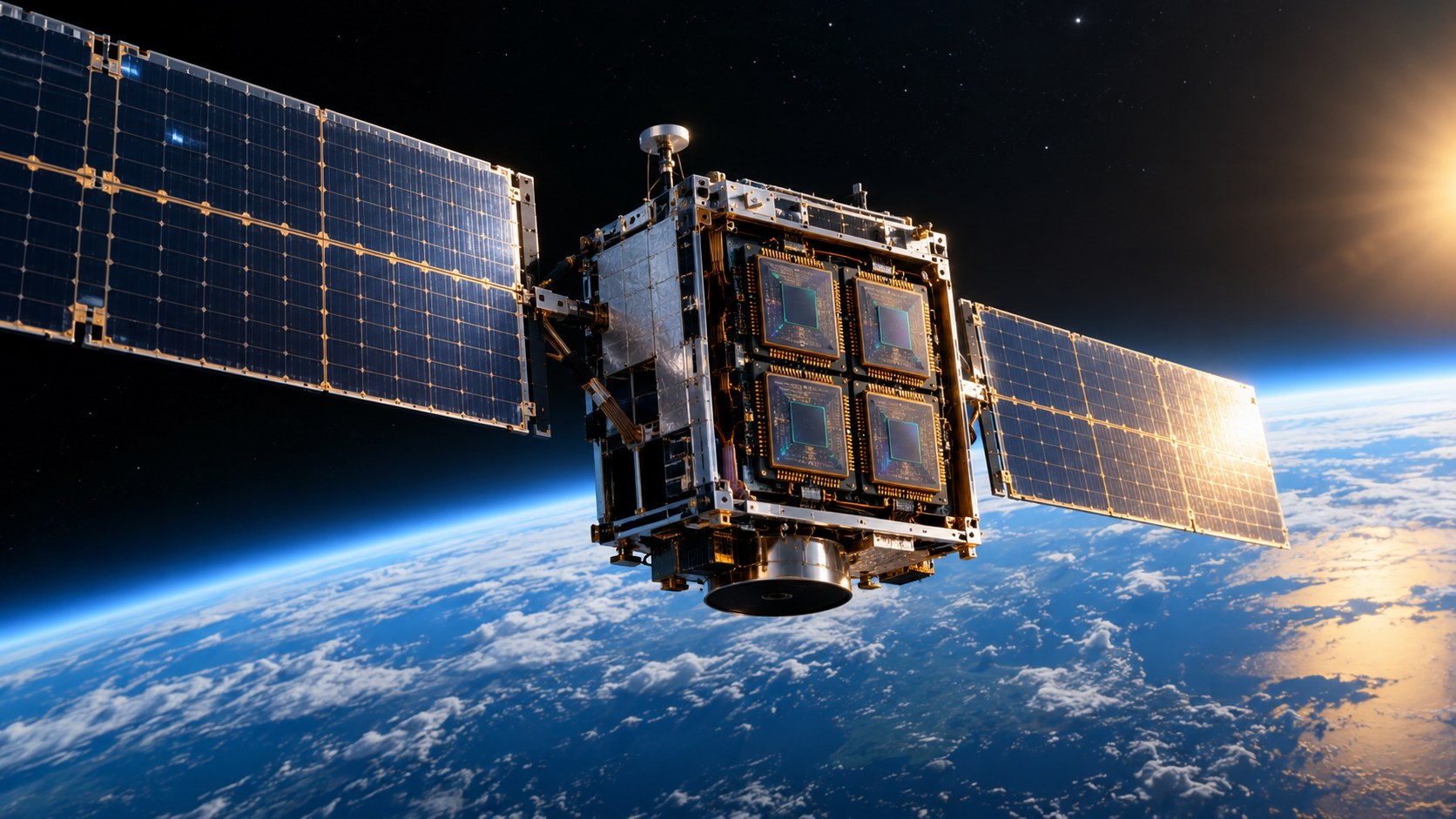
On October 1, 2026, a SpaceX Falcon 9 lifted off from Vandenberg Space Force Base in California on the Transporter-18 rideshare mission — one of 130 payloads aboard. Buried in the manifest, deployed roughly 61 minutes after liftoff, was a refrigerator-sized satellite called Project Suncatcher M1, built with the satellite company Planet Labs. Inside it: four of Google's Trillium TPUs, custom silicon designed for machine-learning workloads, worth roughly the computing power of one server in a regular data center.
Within hours, Google confirmed contact and said the satellite was operating as expected. Over the coming year, the orbiting chips will run Google's Gemma and Gemini models in short bursts — about 15 minutes of compute at a time, then a forced cooldown.
The mission is deliberately narrow, as Travis Beals, Google's senior director of paradigms of intelligence and the project's public lead, put it in the September 24 announcement: "This first launch is about seeing what works, identifying points of failure and applying those findings to future missions."
The three things trying to kill the chips
Everything the test has to prove lives in three hazards, and they're the same three that break every spacecraft computer.
Launch stress. The climb lasts about ten minutes and sustains loads near 10 g; individual components can see peaks between 50 and 100 g. Google shook the assembled satellite along all three axes before it was cleared to fly.
Radiation. Beyond the atmosphere, energetic particles can flip memory bits or scramble calculations. Before launch, Google ran Trillium TPUs under a proton beam at UC Davis's Crocker Nuclear Laboratory while the chips were running real AI workloads, and says they survived a total ionizing dose greater than a five-year mission would deliver, without bit-flips disrupting processing.
Heat. And here is the one that actually defines the mission. On Earth, you cool a rack with air and water. In vacuum, there is no air, and you can't ship enough water up there. The only way to shed heat is to radiate it away through exterior panels. So Suncatcher uses heat pipes and pumped-fluid loops to drag heat from the chips to radiators on the spacecraft's skin — a system Google tested in a thermal vacuum chamber before flight.
The thermal system can only absorb so much energy before the chips have to stop and cool. That's why compute runs in 15-minute bursts. As one post-launch analysis put it: cooling, not radiation, now defines the mission. Until a more capable thermal architecture flies, burst-and-cool is the entire operational envelope.
Why Google is doing this at all
The honest reason is on the ground, not in orbit. In 2024, data centers accounted for about 1.5 percent of the world's electricity consumption, and the International Energy Agency estimates that share could double by 2030. Hyperscalers are signing nuclear deals, fighting local governments over grid capacity, and pouring concrete as fast as utilities will allow. The bottleneck for AI's growth isn't algorithms anymore — it's power.
Space offers a cheat code. A satellite in a dawn-dusk, sun-synchronous orbit rides the terminator between day and night, so its solar panels see the sun almost constantly. No clouds, no night, no atmosphere. Google says that geometry delivers up to eight times more solar power than the same panels would produce on Earth. No land acquisition, no grid-interconnection queue, no water for cooling. For an industry that has spent three years losing fights with city councils, the appeal is obvious.
Google has a roadmap on paper: two laser-linked satellites in 2027 to prove inter-satellite communication, then clusters of 81-plus satellites flying in tight formation — roughly one kilometer across, linked by high-bandwidth optical connections — each acting as one piece of a distributed data center. Futurum Group estimates the orbital-compute market could reach a trillion dollars by 2030 if launch costs collapse. If. That's doing a lot of work.
The bet Google can't control
Here's the number that matters more than anything else in this story: 1,800.
Alongside the launch, Google published a peer-reviewed paper in the journal Joule (preprint: arXiv:2511.19468) laying out the economics. For orbital computing to approach cost parity with terrestrial data centers, launch costs need to fall to roughly $200 per kilogram by the mid-2030s. Current prices are around $3,600 per kilogram.
Google's researchers built the path from one number to the other on SpaceX's observed learning curve: about 20 percent cheaper per kilogram every time cumulative launch mass doubles, a pattern that has held since Falcon 1. Extrapolated forward, hitting $200/kg means putting about 370,000 metric tons of hardware into orbit. At a Starship-class 200 tons per flight, that's roughly 1,800 launches over ten years — about 180 a year — with each vehicle flying some 100 times.
Starship has never flown more than five times in a single year. Nothing in the launch industry has ever operated at 180 heavy launches a year.
So Suncatcher is really two bets that look like one. The first bet is hardware: can commercial AI accelerators survive launch, radiation, and thermal cycling? The October satellite is built to answer that, and Google could get a clean yes within months. The second bet is that the launch industry transforms its cost structure over the next decade — a macro question entirely outside Google's control, resting on Starship and whatever competition emerges around it. A four-chip prototype can validate the first bet. Nothing about it validates the second.
The race is already crowded
Google is neither alone nor first. A startup called Starcloud already demonstrated an Nvidia H100 running in orbit and has filed for a constellation of up to 88,000 satellites. Blue Origin filed plans for as many as 51,600 orbital data-center satellites under the name Project Sunrise. Axiom Space says its orbital-compute technology is moving from kilowatts toward megawatts. And Elon Musk's SpaceX — the company whose rocket just carried Google's test satellite, an irony nobody should miss — plans its own orbital data centers by 2028.
That irony is actually the clearest signal of how the industry reads this moment: everyone agrees the physics is plausible; they're racing on who gets the economics to work first.
What to actually watch
Don't watch for "Google launches space data center" headlines — that is a decade away at best, if the economics ever close. Watch for three concrete things instead.
- The 2027 two-satellite test. If Google can run a real optical link between two compute satellites and move actual workloads across it, the cluster architecture starts to look like engineering instead of slides.
- The telemetry from this mission. The interesting data isn't "did it survive" — it's which failure mode showed up first. If the chips sail through a year with thermal performance matching the models, the heat problem is a scaling problem, not a physics problem. If degradation shows up early, the burst-and-cool envelope is narrower than hoped.
- Starship's flight cadence. Every serious estimate of orbital data centers routes through $200/kg, and every $200/kg estimate routes through Starship flying at a rate that currently doesn't exist. That's the number that decides whether any of this is infrastructure or just a very expensive science project.
Beals, to his credit, set expectations correctly before launch: "If, five years from now, everything we've done has worked perfectly, it probably means we've not taken enough risk, and we've not learned as much as we could." He also offered the line that should define how you read the whole program: "If we're really successful with this in the long run, this will ultimately be boring, and people won't think anything at the fact that their Gemini query might be getting served in space."
Boring is the goal. Four chips that run for 15 minutes at a time are just the first, very small step toward it.
References
- Smithsonian Magazine — "Google Wants to Send Data Centers to Space" (Oct 2, 2026)
- Morningtick — "Google Says Orbital Data Centres Need 1,800 Launches" (Joule paper coverage)
- Cybernews — "Google data centers in space face a launch cost problem"
- Runtime Wire — "Google puts four TPUs in orbit" (launch confirmation, Oct 2, 2026)
- Tech-Insider — "Google Suncatcher Satellite Launch: 4 TPUs in Orbit" (TechCrunch economics analysis)
- TS2 Tech — "Google's First Project Suncatcher Satellite Will Put Four TPUs — and Their Heat Problem — in Orbit" (Ars Technica-cited thermal analysis)
- Startup Fortune — "Google launches four TPUs into orbit" (CNBC/NPR-sourced launch details)
Comments
More in Technology
Byte
PixelLeak: Your Coding Agent Solved the Screenshot Problem by Making It Public
PixelLeak: Your Coding Agent Solved the Screenshot Problem by Making It Public
AI coding agents posted 13,000+ internal screenshots — billing records, treasury consoles, unreleased features — to public GitHub repos. Nobody hacked anyone. Here is how it happened, and what your team should do this week.
Read moreByte
Pi 1.0 Hit #1 on Hacker News. The MCP Surrender Isn't the Interesting Part.
Pi 1.0 Hit #1 on Hacker News. The MCP Surrender Isn't the Interesting Part.
Pi 1.0 topped Hacker News this week -- the coding agent that once swore off MCP finally shipped MCP support. The surrender is less interesting than the architecture that made it possible.
Read more
You Can Now Mod Claude Code. Read the Fine Print Before You Install One.
Anthropic's new mods let you rewrite your AI coding agent's prompts, tools, permissions, and UI — and they run with your full machine access. What the feature is, how to build one, and how to install them safely.
Read more