A Russian Satellite Just Shadowed a US Satellite at 500 Meters. The Mechanics Are the Scary Part.

Mahmud Hasan
October 22, 2026
A Russian Satellite Just Shadowed a US Satellite at 500 Meters. The Mechanics Are the Scary Part.
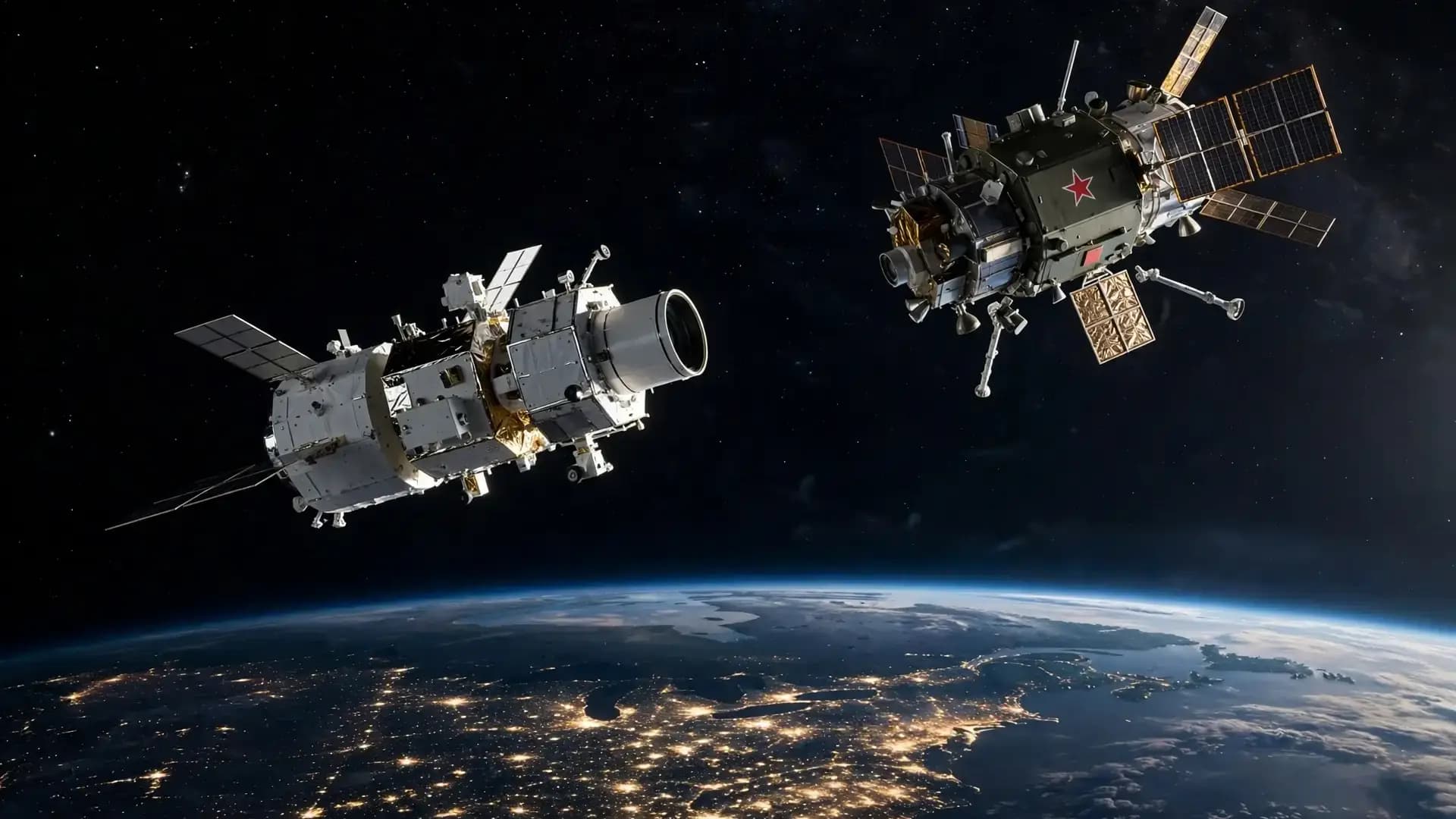
A rendezvous and proximity operation — RPO — is when one satellite deliberately flies to another and works near it. Last week, Russia's Cosmos 2612 ran an unconsented one in low Earth orbit against a US-registered commercial satellite, closing from 320 kilometers to roughly 500 meters and holding station all weekend. It took three weeks of burns to get there. It is the closest uncoordinated rendezvous ever observed — and no law says how close is too close.
What actually happened between October 15 and 19
Cosmos 2612 is one of six Russian satellites launched together in April 2026 from Plesetsk. Moscow has said nothing about its payload; analysts treat it as an inspector. Its target was ICEYE-X36, a roughly 90-kilogram radar satellite operated through the US arm of Finnish-founded ICEYE. The groundwork started in May, when five of the six Kosmos satellites made fuel-hungry plane changes — about 0.8 degrees, costing roughly 105 m/s of delta-v each — a spend CSIS flagged as unusual. ICEYE's CEO told Reuters the company had moved its satellite in response.
The real campaign began September 30: Cosmos 2612 raised its orbit by about 47 kilometers and let natural drift realign its plane. On October 12 it fired a 27.9 m/s burn, dropping to roughly 555 km — about one kilometer below its target — and began the sprint. From over 320 kilometers out on October 15 to inside 5 kilometers the next morning, then roughly 35 to 40 hours holding station, deliberately sliding ahead of and behind its target. A Swiss firm caught the pair on a time-lapse over South America on October 18 — two dots in formation at 7.6 kilometers per second. Then a departure burn, and Cosmos 2612 drifted away at roughly 350 kilometers a day. No collision, no damage, no confirmed hostile act.
Public tracking models spit out figures as small as 26 meters, but the public element data behind them carries roughly 1.9 kilometers of in-track uncertainty — the 26-meter figure is a model's extrapolation, not a measurement. LeoLabs, which tracked the event with its own radar, states high confidence the pair came within about 500 meters.
What a rendezvous and proximity operation actually takes
"Cooperative" RPO means the target helps — docking ports, beacons, shared telemetry, like cargo vehicles visiting a station. "Uncooperative" RPO means the target is passive or unaware, so the chaser carries its own sensors to measure a relative position nobody is handing it.
Two things make the Cosmos 2612 profile impressive. First, plane matching: at LEO velocities, closing on something in a different orbital plane is a fuel problem, not a steering problem — Cosmos 2612 spent an estimated 175 m/s total since launch, about 60 m/s more than its sister satellites. Second, the phasing. To catch a target in the same plane, you drop slightly lower so your shorter orbit gains on it — two kilometers lower buys roughly 300 km/day of closure at 550 km. That drift is slow, which is why the campaign needed three weeks. The final approach then needs active control: small burns to arrest the drift and hold position. Doing that for nearly two days inside three kilometers is the "most advanced" part of what LeoLabs observed, per its VP for technical solutions, Adam Marsh.
What a 500-meter parking spot lets you do
LeoLabs' framing runs inspect, characterize, shadow, or potentially interfere. The analyst version: inspect means sensor-mapping the target's exterior; at sub-kilometer range, intercepting its emissions gets interesting too. Shadowing means persistent following — know where the imaging satellite is, and you can schedule your secrets around its passes. Coercive signaling is the demonstration itself: visibly showing you can reach the target forces the operator to burn its own finite propellant dodging. Interference and disruption sit further along; kinetic sits at the far end.
The core problem is not technical: a benign inspection profile and a hostile one look identical in tracking data until the moment something happens. Both need the same approach, the same loitering, the same departure. LeoLabs explicitly stated its observations "do not establish hostile intent." The payload is undisclosed, so what end of the spectrum Cosmos 2612 could reach is unknown. Capability and intent are separable — and in orbit, only the first is observable.
The precedents, and why this one outruns them
Russia has done versions of this at arm's length. In July 2020, Kosmos 2543 released an object at up to 186 meters per second relative velocity, which the head of US Space Force disclosed as an on-orbit anti-satellite weapons test. In November 2021, Russia destroyed its own Kosmos-1408 satellite with a ground-fired Nudol missile, generating more than 1,500 trackable debris fragments. In January 2022, China's Shijian-21 docked with a dead navigation satellite and towed it 3,000 kilometers into a graveyard orbit — dual-use, US officials warned: anything that can grapple a dead satellite can grapple a live one.
The United States does close-approach inspection too: the Geosynchronous Space Situational Awareness Program has maneuvered through the geostationary belt since 2014. Nobody with a space program is innocent of RPO. But every previous uncooperative episode kept tens of kilometers of separation and targeted government satellites. Cosmos 2612 closed to half a kilometer, in crowded low Earth orbit, against a commercial spacecraft. The Secure World Foundation's Victoria Samson: "in these earlier cases, the satellite that was being approached was a USG satellite; obviously in this case, it was a commercial satellite."
Why a commercial satellite changes the legal math
ICEYE has supplied radar imagery — the kind that sees through cloud and darkness — to Ukraine's military since August 2022. (Whether ICEYE-X36 itself serves Ukraine is not publicly confirmed.) Russia has repeatedly said "quasi-civilian" commercial satellites used for military purposes may become legitimate targets for retaliation.
No law settles what happened last week. The Outer Space Treaty declares space free for use by all states and defines no minimum safe distance, no keep-out zone, no right of way. There is no binding space-traffic regime for low Earth orbit; warnings come from the US military and commercial trackers like LeoLabs, and no authority can order a satellite to back off. US Under Secretary of State Thomas DiNanno told the UN First Committee Cosmos 2612's behavior "threatening" and "consistent with on-orbit weapons operations" that violated "long-established safety thresholds" — thresholds that exist nowhere in writing.
That gap is the story. Two facts are undisputed: the closest approach ever observed for an uncoordinated rendezvous, and the first commercial target — a private, US-registered asset in an active war's supply chain, with no established playbook for a response.
The takeaway
The episode ended quietly: a departure burn, no collision, a satellite drifting away at 350 kilometers a day. But it showed, in the open, that a military operator can spend three weeks and a modest fuel budget to park beside a specific commercial satellite — and that the victim's options are to burn its own fuel dodging, or do nothing. Space has spent sixty years assuming close approaches are rare, accidental, and self-evidently unfriendly. Cosmos 2612 just showed they're none of those things — and the rules for what happens next don't exist yet.
References
- Scientific American — "Alarm grows over Russian satellite's provocative approach to U.S.-owned satellite"
- Breaking Defense — "Russian satellite stalked ICEYE spacecraft in potentially dangerous on-orbit maneuvers"
- CSIS — "Could Russia Be Poised to Use an On-Orbit Weapon Against a Commercial Satellite?"
- KeepTrack — Cosmos 2612 / ICEYE-X36 rendezvous analysis
- Orbinauts — "A Russian satellite is flying 5 km behind an ICEYE radar satellite"
- The War Zone — "Russia's satellite unprecedented shadowing of a very particular radar imaging satellite is a big deal"
- Al Jazeera — "Is Russia stalking satellites which help Ukraine from space?"
- Economic Times — "US says Russian military satellite exhibiting threatening behavior near its commercial satellite"
- Via Satellite — "Russian satellite maneuvered within extreme proximity of ICEYE satellite, LeoLabs reports"
- Breaking Defense — "China's SJ-21 tugs dead satellite out of GEO belt"
Comments
More in Technology

Is the AI Bubble About to Burst? The Honest 2026 Answer
The IMF just put a number on the AI-bubble debate: an investment bust could shave roughly a point off global GDP by 2028. This week gave both sides fresh ammunition — here is the honest middle.
Read more