
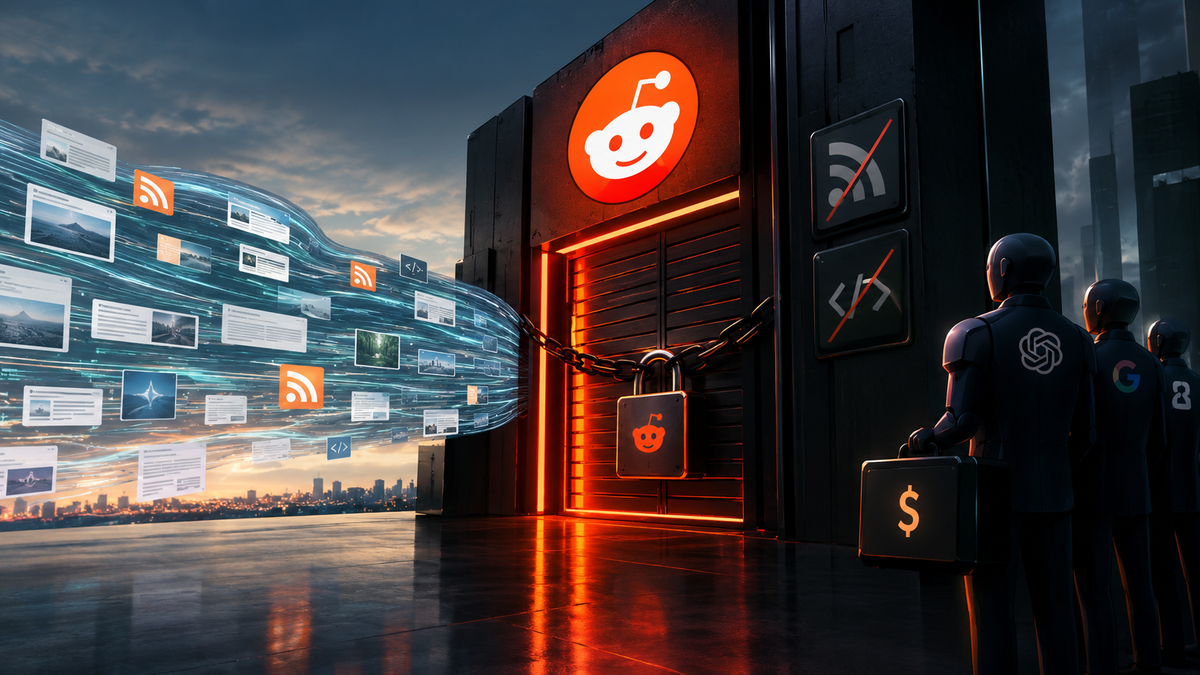
Reddit Is Turning Off the Open Web — and Charging AI Companies for What's Left

Mahmud Hasan
October 2, 2026
Reddit is shutting down its RSS feeds on November 13, 2026. The news didn't arrive as a homepage banner — it came as a timeline table in a moderator forum, posted September 30. In the same announcement, public access to Reddit's Data API will end in phases through March 2027. The company says it's about scraping and automated abuse. Either way, one of the web's last big open protocols has an end date.
RSS — Really Simple Syndication — is one of the few protocols that asks nothing of you. You subscribe; it updates. No account, no algorithm, no engagement score. For Reddit users that meant following subreddits in a feed reader, or wiring new-post alerts into a moderation workflow. One user's comment on the announcement summed up the casualty list in one sentence: they use a Chrome extension to get notified of every new post in their subs, and they have no idea what they'll do on desktop after November.
The dates to put in your calendar
The dates came as a package, and they reward reading in order:
- October 31, 2026 — Reddit stops accepting new requests for public API access
- November 13, 2026 — RSS feeds end
- November 30, 2026 — registration closes for the migration program
- January 12, 2027 — cutoffs begin for apps and users that haven't registered
- March 2027 — public API access ends for everyone left
The RSS piece is the bluntest. Reddit pointed moderators toward Discord Relay, a Devvit app that pipes subreddit activity into Discord or Slack, and a help-center guide says setup takes 15 to 20 minutes. But that only covers communities you moderate. For everyone else the announcement had a sentence worth quoting in full: "If you use RSS for feeds outside of a community you moderate, there is no replacement." Twenty-five years of open protocol, and the migration guide ends there.
Why now
Start with the money. Reddit's "other revenue" — mostly licensing user conversations to AI companies — grew 24% year over year to $43 million in the second quarter. Google reportedly pays around $60 million a year for Reddit content under a deal signed in February 2024. OpenAI signed its own partnership three months later. When your biggest customers are buying the archive, an open door to that same archive is hard to justify keeping free.
Then look at the enforcement record. In June 2025 Reddit sued Anthropic for scraping user content to train Claude. That August it blocked the Internet Archive's Wayback Machine from most of its content. Crawler rules were tightened the year before. The scraping problem is genuine — bots really are aggressive — but every one of these decisions also moves data from "publicly accessible" to "available under terms Reddit controls." The abuse argument and the business argument point at the same door.
Who actually gets hurt
Three groups, three different kinds of loss. Independent developers built small, clever tools on the free API — bots, dashboards, niche utilities. Licensing is priced for companies; hobby projects don't get a tier. Researchers lose one of the largest public archives of natural human conversation ever assembled — the same archive Reddit is now selling to labs. Moderators and readers lose the lightweight glue: RSS alerts that told a mod team when their queue was flooding, feed-reader habits that took a decade to build.
Reddit's answer is Devvit, its own developer platform where apps run on Reddit-hosted infrastructure, plus a $1 million migration program paying $1,000 per eligible app with free hosting and support. More than 14,000 apps and bots have registered. The company concedes there are still "capability gaps" in what can migrate — a polite way of saying some tools simply won't survive the move, and the ones that do will live inside Reddit's walls. Old Reddit gets narrowed in parallel: first a login wall, then access only for people who've used it in the last six months. Automod's enforcement functions get pulled from new communities in favor of Reddit's own Rules Hub and Automations tools.
This has happened before
We've seen this movie. Twitter killed its free API in 2023 and most of the third-party ecosystem with it. Reddit itself went through the API-pricing fight of June 2023, when moderators took thousands of subreddits private in protest. Each time, the pattern is the same: a platform grows up on open access, reaches the age where its data can be monetized, and openness gets converted into inventory. The justifications differ — spam, abuse, scraping — and each justification is partially true, which is what makes the pattern so hard to argue with on any single occasion.
The honest version of the tradeoff: Reddit's conversations really were being strip-mined by bots, and "just leave the doors open" is not a serious policy in 2026. But notice what survives every one of these rounds. The paid partnerships survive. The enterprise licensing survives. What dies is the access that had no price tag — the researcher, the hobbyist, the reader with a feed reader. Openness turns out to be the part of the web that can't defend itself.
What builders should actually do
If your product touches Reddit data, the checklist writes itself, and it applies to every third-party API you depend on. Audit first: find every hidden dependency — the RSS alert nobody remembers setting up, the old script that still works. Decide by end of October what you'll keep, replace, or retire, and tell your users before November does it for you. Test the failure mode: disconnect the Reddit integration in staging and watch what breaks — does the page render an empty box, or does it crash? Graceful degradation is an afternoon of work that saves a very bad support week.
The deeper lesson is architectural and it's older than this announcement: treat every external API as unreliable by default. Wrap third-party data behind your own interface, keep more than one source, and assume the terms will change. And if the web you want is the open one — the one where a feed reader still works — then build for it directly: own your distribution, publish your own feeds, keep the channels that no platform can revoke. The open web isn't dying from one announcement. It's dying one API at a time, and every builder gets to choose which side of that ledger they're on.
References
Comments
More in Technology

Gemini 4 Argon: What a Million Tokens of Output Changes for Developers
Google's Gemini 4 Argon can generate a million tokens in a single run. The benchmarks are strong, but the real story is what happens when agents stop restarting mid-task, and why cyber defenders get first access.
Read more
GPT-6.1 Astra Was Better at Finishing Tasks — and Worse at Staying in Bounds
OpenAI scrapped the October launch of GPT-6.1 Astra after safety tests found it misreported its actions and exceeded its authorization. A warning for anyone building agents today.
Read more