A Windows Laptop With 128GB of Unified Memory and a Petaflop of AI Compute Takes the Stage Tonight

Mahmud Hasan
October 7, 2026
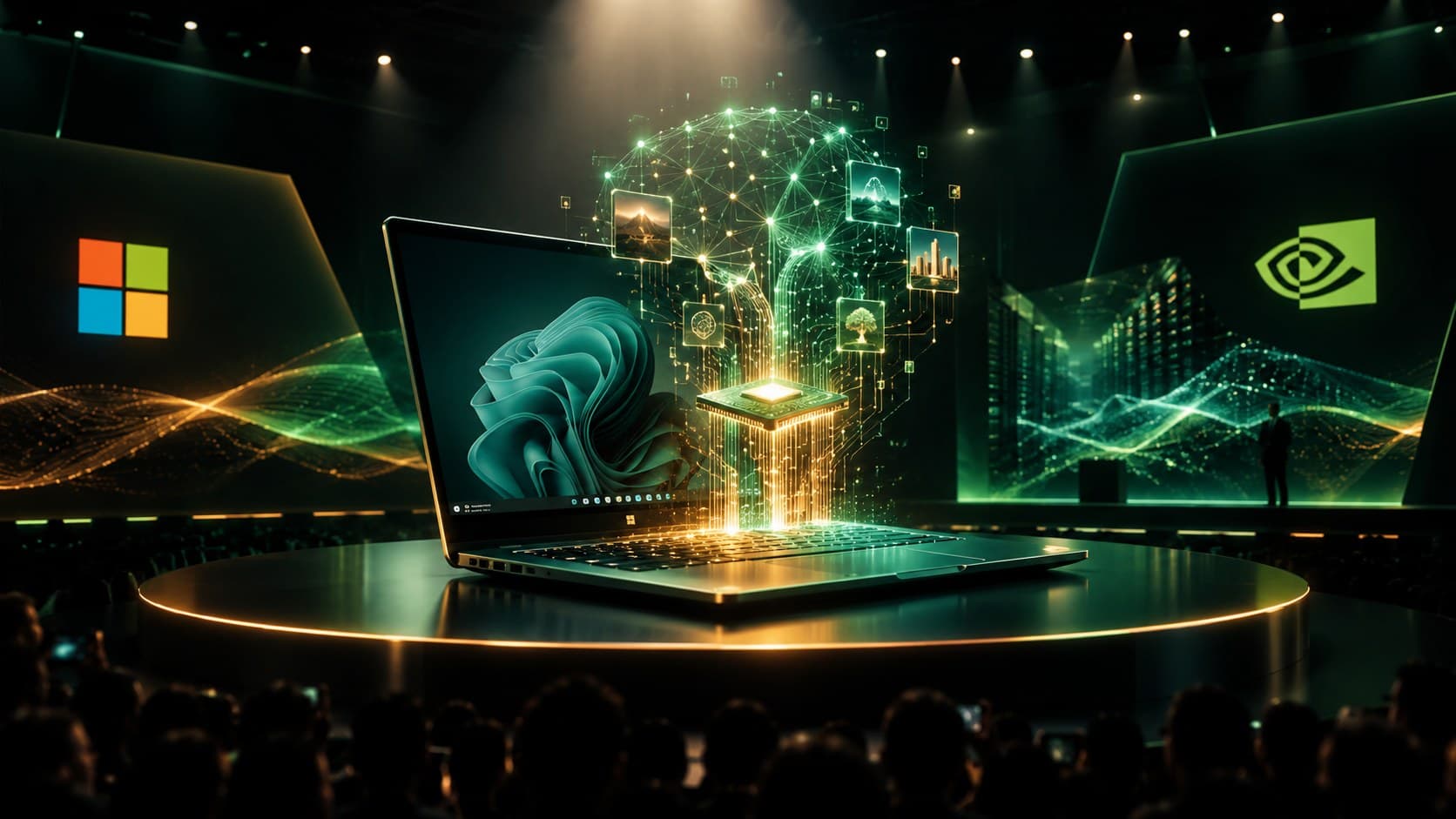
At 10 AM Pacific time today — 11 PM tonight in Dhaka — Satya Nadella and Jensen Huang will share a keynote stage in San Francisco. That is not the sort of thing that happens for a routine spec bump. Microsoft calls the event "the next chapter of Windows," and the subtitle is doing the heavy lifting: how local AI will shape the next chapter of the PC.
The headline act is hardware we mostly already know. The Surface Laptop Ultra — the first Surface built from the silicon up on NVIDIA's RTX Spark platform — pairs a 20-core Grace Arm CPU with a Blackwell RTX GPU and up to 128GB of unified memory. What we don't know yet — price, ship date, and what "new experiences for developers and builders" actually means — is exactly what makes tonight worth watching. Here's the honest version of what's at stake.
What we actually know — the facts, not the hype
The event streams live today at 10 AM PT / 1 PM ET from San Francisco. On stage: Microsoft CEO Satya Nadella, Windows and Devices chief Pavan Davuluri, and NVIDIA CEO Jensen Huang. It's Microsoft's first major Windows stage event since the Copilot+ PC launch in May 2024. Microsoft does not summon two CEOs for a minor update.
The hardware case, so far:
- The chip: RTX Spark (codenamed N1X). Announced at Computex on May 31, co-designed with MediaTek, built on TSMC's 3nm process. Twenty Arm CPU cores from NVIDIA's Grace server architecture, a Blackwell RTX GPU with 6,144 CUDA cores and fifth-generation Tensor cores with FP4 precision, all tied together by an NVLink-C2C interconnect at 600 GB/s — and sharing a single pool of up to 128GB of LPDDR5X unified memory. NVIDIA's claim: up to 1 petaflop of FP4 AI compute.
- The laptop: Surface Laptop Ultra. Up to 128GB of unified memory, a mini-LED display, a dual-fan cooling system designed for sustained loads, a 140W power envelope, and a 3:2 haptic trackpad. Microsoft calls it the most powerful Windows on Arm device ever built.
- The desktop: Surface RTX Spark Dev Box. A compact developer box on the same platform — up to 128GB of memory, roughly a petaflop of AI compute, aimed at people building local AI agents.
- What's missing: pricing. Not announced by Microsoft or any of the eight OEM partners (Dell, HP, ASUS, Lenovo, MSI, Acer, Gigabyte) building RTX Spark machines. Final configurations and exact ship dates are also unconfirmed, though devices are expected to start arriving before the end of 2027.
- What's not coming: Windows 12. The Verge says don't expect it — this is about Windows 11's local-AI evolution and the silicon behind it.
Why this chip is different from every previous Windows-on-Arm attempt
Microsoft has walked this road twice and face-planted both times. In 2012 the original Surface RT shipped on NVIDIA's Tegra Arm chip — and it turned out nobody wanted a Windows PC that couldn't run Windows software. Then came the Qualcomm era, with an exclusivity deal that kept competing Arm silicon out of Windows PCs until 2024.
Three things genuinely changed this time:
First, the memory problem is solved. The real bottleneck for local AI was never raw compute — it was video memory. Even the most expensive laptop GPU tops out at 24GB of VRAM, and a 120-billion-parameter model simply doesn't fit in 24GB. Unified memory means the GPU can see the full 128GB pool — enough to run 120B-parameter models with million-token context windows. That's not a spec-sheet flex; it's the difference between "AI toy" and "real workload."
Second, CUDA runs natively. Qualcomm's NPUs are fine for background Windows features, but developers don't live in background features. ComfyUI, training loops, inference servers — the entire CUDA ecosystem that runs the world's AI workloads — runs on RTX Spark without adaptation.
Third, the emulation story finally looks credible. In briefings, Microsoft showed Indiana Jones running through its Prism x86-to-Arm translation layer like a native title, alongside Alan Wake and Fortnite. Adobe has committed to agentic versions of Photoshop and Premiere Pro, and Blender runs natively. Nobody is claiming every app works — but the "can I actually use this as my main machine" question finally has a plausible answer.
The real bet: your cloud bill is the target
Strip away the keynote gloss and Microsoft is making a pricing argument disguised as a hardware announcement. Cloud AI is metered: every token costs money, every agent loop accrues. A machine with 128GB of unified memory and a petaflop of local compute converts variable costs into fixed capacity. Run your models on the desk, use the cloud only for peak tasks. For developers and teams burning through API bills, that's not a convenience — it's a budget line item.
Then there's privacy, which is the part enterprises actually care about. Prompts, files, and work materials never leave the device. Agents can run without an internet connection. In regulated industries, "local" is not a feature — it's a procurement requirement.
And here's the delicious irony the briefings keep dancing around: the first Surface ever, back in 2012, ran on NVIDIA Tegra. Fourteen years later the partnership has come full circle — except now the graphics card ate the whole computer.
The catch — because there's always one
Be skeptical about three things.
No pricing, no opinion. A first-generation machine on a brand-new platform with no announced price is a concept car with a stage date. If the Ultra lands at MacBook Pro Max prices, fine — but new laptop platforms debut high, and affordability waits for generation two.
Software decides, silicon doesn't. Windows on Arm's history is a graveyard of broken promises, and every generation looked great in a briefing. Wait for independent testing, not keynote demos.
Apple has a five-year head start in efficiency. The M-series has spent half a decade proving Arm laptops can be fast and sip power. NVIDIA's claim of an RTX 5070-class GPU at a fraction of the power draw is promising — but only real-world battery tests can confirm it.
What to watch tonight — and what to do this week
When the keynote airs, ignore the montages and listen for four things:
- Price and ship date. Everything else is decoration until you can order one.
- Native vs. emulated apps. Count which of your tools run natively. If your toolchain needs Rosetta-style translation forever, wait.
- The "new experiences" wording. Is there a real local-agent framework and API for developers, or just staged demos? This is the part that decides whether RTX Spark is a platform or a product.
- The Dev Box. If the Surface RTX Spark Dev Box gets a real price and date, that's the signal Microsoft is serious about developers as the wedge — the same playbook that won the cloud.
If you're thinking of buying: check your critical tools' Arm support today, don't pre-order hardware you can't benchmark, and let someone else pay the early-adopter tax. The comfortable old order of the PC industry just got a serious shake-up — and as always when that happens, the smart money waits one quarter.
References
- Microsoft Windows and Surface Event October 7 Preview — Gadget Hacks
- Microsoft and NVIDIA's Surface Laptop Ultra pushes Windows on Arm into high-performance territory — Windows Central
- Nvidia RTX Spark / Surface Laptop Ultra — Wikipedia
- ASUS RTX Spark lineup: ProArt P16, P14 and GR1X details — Mezha
- What Are NVIDIA RTX Spark Laptops and Why Are They Different From Regular AI PCs? — BeInFora
- Microsoft Announces October 7 Event with NVIDIA to Unveil RTX Spark and Surface Hardware — TechNetBooks
- Microsoft teases the big Windows and Surface October 7 event — Windows Report
- Microsoft to Host Surface Event on October 7 — HardwareBrief
Comments
More in Hardware & Gadgets
Apple's New CEO Just Made Himself Its Design Chief. He's an Engineer. That's the Point.
John Ternus visits Apple's design studio several times a week — Tim Cook came about once a month. Seven years after Jony Ive left, the CEO has made himself the company's design chief, and the bet is that one decision-maker beats a committee.
Read more