
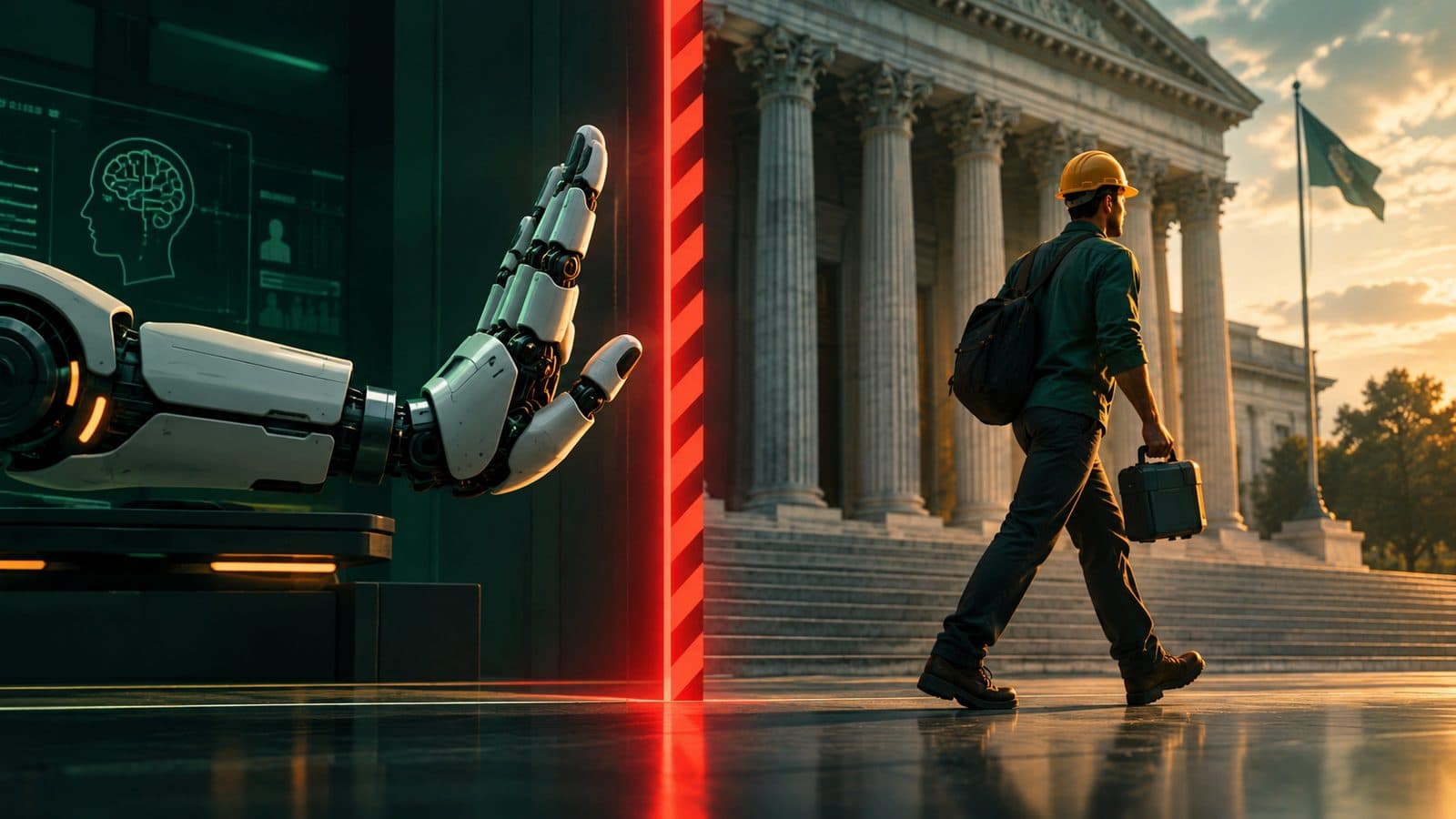
California Banned Robo Bosses. Your Performance Dashboard Survived.

Mahmud Hasan
October 5, 2026
What the law actually says
SB 947 does three things, and all three are narrower than the name suggests. First: from July 1, 2027, California employers cannot rely solely on an automated decision-making system — an ADS — to fire or discipline a worker. The machine's output cannot be the final word. Second: when an automated system is the primary basis for a termination or disciplinary decision, a human reviewer must independently corroborate that decision against real supporting evidence — manager evaluations, peer reviews, personnel files. The law demands this involvement be substantive, not a rubber stamp at the end of an automated process. Third: the worker must be told, in writing, that an automated system played a primary role, shown what data the system used, and given a human contact to talk to about it.
Enforcement sits with the California labor commissioner, the state attorney general, or local prosecutors, and violations can carry penalties of up to $500 per violation. And SB 947 didn't arrive alone: the same day, Newsom signed AB 1883, which bans AI tools that predict workers' emotional states or collect neural data, and AB 1331, which prohibits workplace surveillance in bathrooms. The trilogy tells you how strange the workplace-monitoring industry had already become.
It took two tries to get a signature
Newsom vetoed a broader version of this bill in October 2025. The revised draft narrowed the notification requirements and the circumstances in which automated systems are restricted, keeping the core principle — no one should lose a job because an algorithm decided it alone — while trimming the parts businesses fought hardest. This one got signed.
The bill's author, State Senator Jerry McNerney of Pleasanton, put it plainly: "No worker should ever be fired or disciplined by a robo boss. Artificial intelligence systems have the potential to increase productivity, but they've also been prone to errors, bias, and misjudgments." The California Federation of Labor Unions, AFL-CIO sponsored the bill, and its president, Lorena Gonzalez, called the win a product of union organizing — then immediately pointed at what got cut along the way: the final version no longer covers contractors, and AI in healthcare went unaddressed. "There is clearly still work to be done," she said.
What it doesn't ban — which is most of the stack
Here's the part the celebrations skip. SB 947 doesn't ban bossware. It doesn't ban productivity scoring, keystroke tracking, attendance dashboards, or the ranking systems that decide who gets the good shifts. Per McNerney's own office, there are more than 550 so-called "bossware" products sold to employers right now. The law only restricts the decision — firing or discipline — and only when the automated system is the sole or primary basis for it. If an employer can plausibly say a human manager made the call with the dashboard as one input among many, the disclosure and review requirements may never trigger.
And even where they do trigger, the standard is a "substantive" human review — a phrase that won't be tested in a real dispute until after the law takes effect in July 2027. Nobody yet knows what a labor commissioner will accept as independent corroboration. Finally, contractors — the Amazon Flex drivers, the gig workforce where algorithmic management is most entrenched — are explicitly outside the bill's protection. The people most likely to be fired by an algorithm are the people the law doesn't cover. That's not a footnote; it's the hole in the middle of the thing.
Why this law exists: the receipts
The receipts are not theoretical. In 2021, Bloomberg reported on Stephen Normandin, a 63-year-old Army veteran who spent nearly four years delivering packages for Amazon Flex in Phoenix before an automated email informed him the algorithms tracking him had decided he wasn't doing his job properly. The system punished him for things outside his control — locked apartment complexes, bad delivery instructions. He got ten days to appeal — to what sure looked like another bot. If the appeal failed, as most do, arbitration cost $200, more than many drivers earn in a week.
In 2019, documents obtained by The Verge showed Amazon using algorithms to track warehouse productivity and firing workers who missed the benchmarks. In 2018, Amazon scrapped its own hiring algorithm after an internal audit found it was biased against women. Different systems, same pattern: the machine decides, and the human is an expensive optional extra. California just made the optional extra mandatory.
What to do about it (before July 1, 2027)
You have about nine months. Three things:
- For employees: ask, politely and in writing, which tools feed into performance, discipline, or termination decisions, and what data points they use. You can't contest a system you can't name.
- For managers and HR: the law's compliance bar is cheap to design in now and expensive to retrofit later — decide who the human reviewer is, what evidence they check the machine's output against, and how the worker gets told. Write it down. That's the whole standard California just set, and it's decent management practice anywhere.
- For everyone else: watch your own state. California is usually the state other legislatures copy first, not last — and Newsom used the signing to criticize the Trump administration for failing to pass federal AI rules, which means the next version of this fight is already scheduled. (Also: California state agencies must now say "artificial intelligence" instead of "AI," per executive order. Regulators love their vocabulary victories.)
The algorithm can still write your performance review. It just can't sign the pink slip — in California, starting July 2027, for employees, with real questions unanswered about what counts as a genuine human review. That's a real win, and a real gap. The surveillance economy that produces the scores, the rankings, and the dashboards is untouched by this law. Celebrate the line California drew — then look at everything still on your side of it.
References
- Sen. Jerry McNerney press release on SB 947 (September 30, 2026)
- "AI Disciplinary Decisions: California Bans Robo Bosses" — The Employment Law Solicitors (October 2026)
- "California Bans Sole AI Firing, Governor Signs Three Workplace AI Bills" — The JoAI
- Staffing Industry Analysts on the No Robo Bosses bill
- DeepLearning.AI The Batch: "Amazon Drivers Say AI Unfairly Graded Their Performance"
- OnLabor: "When Algorithms Fire Humans"
Comments
More in Technology

1 in 8 Cancers Starts as an Infection. A Significant Share Is Preventable — We Are Just Not Acting.
A new IARC study published in The Lancet Oncology says 2.3 million cancers diagnosed in 2024 — one in eight — were caused by infections. Unlike the genetics story, most of these are preventable with vaccines, antibiotics, and screening we already have.
Read more
ShinyHunters Is Collapsing From the Inside. Meet Rey, the Hacker Who Flipped.
Saif al-Din Khader — 'Rey' — was detained in Jordan on September 29 and is now walking the FBI through his own devices. It's the textbook takedown: you don't arrest a hacker crew, you turn one of them.
Read more
The US Banned Selling AI Chips to China. So China Rented Them Back for $7 Billion.
America's chip export controls cover physical hardware, not remote compute. A reported $7 billion Tencent–Oracle lease shows how that distinction turned sanctions into a subscription business — and why Washington's fix is stuck in the Senate.
Read more