
Apple's New CEO Just Made Himself Its Design Chief. He's an Engineer. That's the Point.

Mahmud Hasan
October 5, 2026
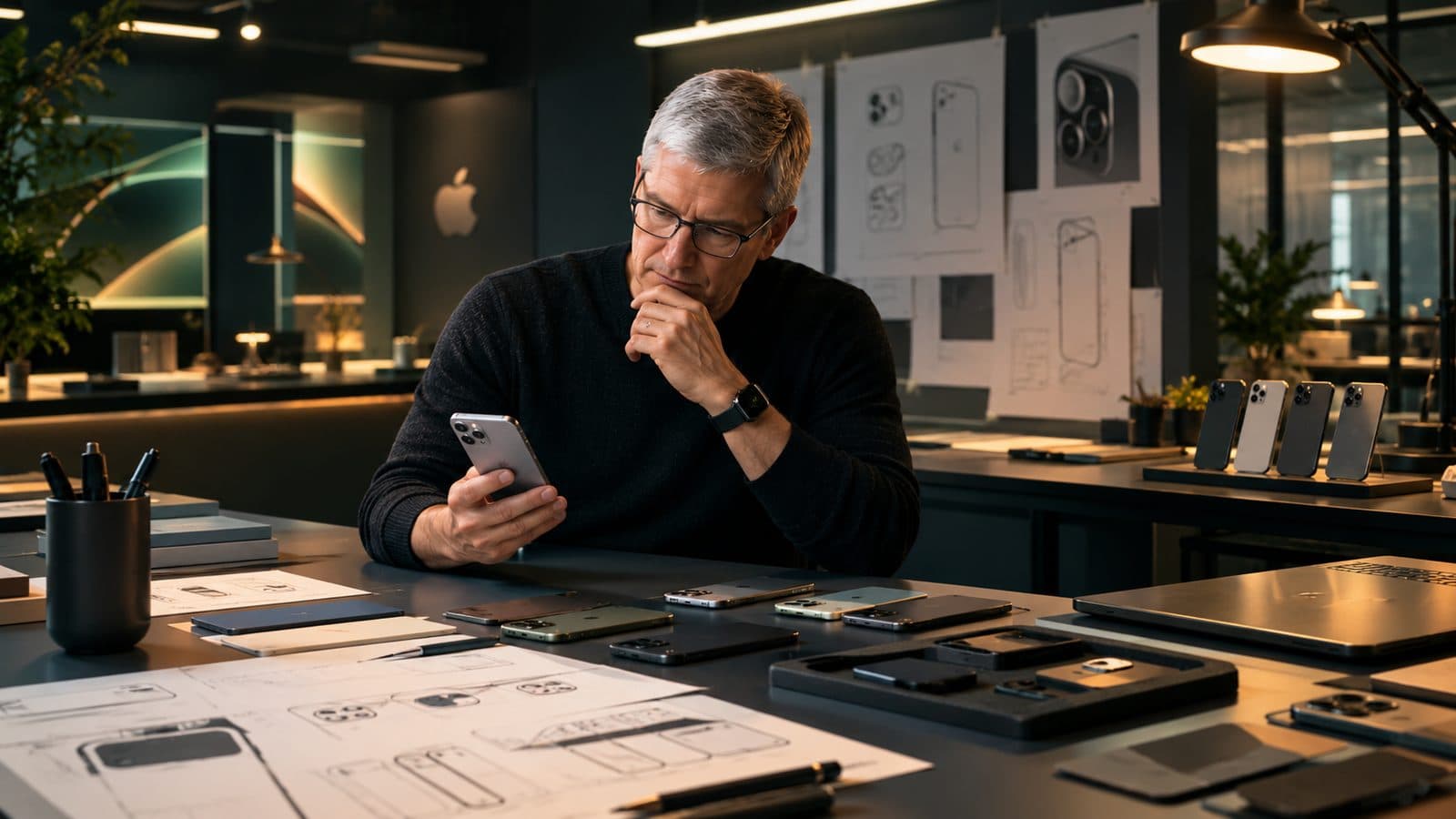
Seven years after Jony Ive walked out, Apple finally has one person in charge of design again. It isn't a designer — it's the CEO. And the new CEO is in the studio several times a week, making decisions himself, while his predecessor showed up about once a month.
The studio went from monthly visits to daily ones
Mark Gurman's Power On newsletter at Bloomberg has the details, and they're blunt. Since becoming CEO, John Ternus has "immersed" himself in Apple's industrial design and human interface teams. People familiar with the department say he works hands-on in the studio several times a week, sometimes visiting multiple times in a single day. He is, per Bloomberg, the ultimate decision-maker across both groups.
The contrast is the story's sharpest line: Tim Cook typically visited the design studio about once a month, for roughly an hour at most. Under Cook, design was a place the CEO checked in on. Under Ternus, it's a place the CEO works.
This didn't start the day Ternus got the title. When former COO Jeff Williams retired at the end of 2025, the design teams were announced as reporting to Cook — but in practice, the portfolio went to Ternus. AppleInsider reported in January that Cook had put him in charge of the design teams as "executive sponsor," handling design discussion at the executive-team level across both hardware and software. There was no official announcement, for an obvious reason: naming him design boss would have publicly anointed him Cook's successor. During the April-to-September CEO transition, the design leaders were effectively Ternus's only direct reports.
And here's the part that tells you what Apple is not doing: according to Bloomberg, there is no search underway for an outside chief design officer. Apple has not had a single person overseeing both design disciplines since Jony Ive left in 2019. Gurman puts it plainly — Ternus has effectively chosen himself as the overall design leader.
The talent problem he walked into
The studio Ternus inherited was thin at the top. The poaching has been brutal and public: Alan Dye, who led human interface design, left for Meta. Evans Hankey, who led industrial design, left and eventually joined OpenAI. Designers have also bled out to LoveFrom — Ive's own firm — and to OpenAI's hardware team. To refill the ranks, Apple has been promoting junior designers and hiring from the outside.
That context explains the two names Ternus is building around. Molly Anderson has led industrial design since 2024, after never having managed a team at Apple's scale before; by Gurman's account she was the only realistic internal candidate left. Steve Lemay took over human interface design after Dye's departure for Meta. Neither is an Ive-style figure with company-wide authority — which is exactly why the CEO sitting above them matters. And the rebuild is ongoing: the industrial design team hired Belgian furniture designer Julien Renault just last week, a hire that tells you Apple is looking for fresh eyes outside its own walls.
The new structure has already had its public debut. At the iPhone Duo launch — the first keynote under Ternus — Anderson and Lemay introduced the device in a joint video, and Anderson posed with Ternus and the phone. The design leaders were placed visibly beside the new CEO. That's not staging; that's the org chart.
An engineer running design sounds wrong. That's the bet.
Ternus joined Apple in 2001 as a mechanical engineer and rose through hardware engineering, running it as SVP. His world is materials, durability, repairability, and manufacturing — the Mac, the iPad, the iPhone, AirPods. He is not a designer, and he reportedly doesn't pretend to be. His line to employees, as reported: design shouldn't act like engineering, and engineering shouldn't act like design. The goal is for both teams to work together from the beginning instead of handing work off over a wall.
There's history in that sentence. Under Ive, design held extraordinary power — and the relationship with engineering was often a standoff. The same era that gave us the iPhone 4's antenna-as-frame gave us the butterfly keyboard: beautiful decisions that engineering had to make real, whether or not physics agreed. Ternus's bet is the inverse arrangement. A CEO who has spent 25 years turning product concepts into manufacturable devices is now the person who decides when a beautiful idea has to survive contact with a supply chain.
He's clearing the calendar for it, too. Financial operations sit with CFO Kevan Parekh; the supply chain with COO Sabih Khan. Ternus spends his product time with Chief Hardware Officer Johny Srouji and hardware engineering leader Tom Marieb. As The Mac Observer put it, he now provides the common decision point the structure has been missing since 2019 — with one open question: whether his engineering background produces more coherent products while still giving designers enough freedom to challenge practical constraints. That's the entire test of this experiment, stated cleanly.
Where you'll see it first
Some of it is already visible. The iPhone Duo launch put the design leads on stage with the CEO — a small signal, but design culture is made of such signals. The bigger test is coming: Gurman reports a redesigned MacBook Pro with OLED and a touchscreen that could be "significantly lighter" through a miniaturized and reorganized internal design. Read that sentence again — lighter through re-engineered internals. That is precisely the kind of product change an engineer-CEO pushes: form achieved through manufacturing, not decoration.
The honest caveat: this is all reported, not announced. Apple has said nothing officially about Ternus's design role, and the company denied nothing either. Gurman's track record on Apple org moves is the reason this story carries weight, but it's still a reporting story. Judge it by what ships.
If you build on Apple's platforms, the practical move is to watch WWDC 2027 and the MacBook Pro redesign the way you'd watch a new API: they will be the first products fully shaped by the Ternus arrangement, and the Human Interface Guidelines will follow wherever the studio goes. And if you run a product org of any size, the structural lesson is the interesting one. Apple tried seven years without a single design decision-maker and apparently concluded that no one is worse than a committee. One person with the authority to say yes or no beats the perfect title every time.
References
- Mark Gurman's Power On newsletter (Bloomberg), via 9to5Mac — "John Ternus is taking a more 'hands-on' role in Apple's design teams as CEO: report" (Oct 4, 2026)
- iClarified — "John Ternus Emerges as Apple's De Facto Design Chief [Gurman]" (Oct 4, 2026)
- The Mac Observer — "John Ternus makes himself Apple's hands-on design chief" (Oct 2026)
- AppleInsider — "Apple's John Ternus is now responsible for design, too" (Jan 22, 2026)
- Gadgets360 — "Apple CEO John Ternus Reportedly Takes Closer Control of Design Teams" (Oct 5, 2026)
Comments
More in Technology
California Banned Robo Bosses. Your Performance Dashboard Survived.
On September 30, California became the first state to ban AI-only firings. The law has real teeth — but it doesn't touch the surveillance software scoring you every day. Here's the fine print.
Read more
1 in 8 Cancers Starts as an Infection. A Significant Share Is Preventable — We Are Just Not Acting.
A new IARC study published in The Lancet Oncology says 2.3 million cancers diagnosed in 2024 — one in eight — were caused by infections. Unlike the genetics story, most of these are preventable with vaccines, antibiotics, and screening we already have.
Read more
ShinyHunters Is Collapsing From the Inside. Meet Rey, the Hacker Who Flipped.
Saif al-Din Khader — 'Rey' — was detained in Jordan on September 29 and is now walking the FBI through his own devices. It's the textbook takedown: you don't arrest a hacker crew, you turn one of them.
Read more