
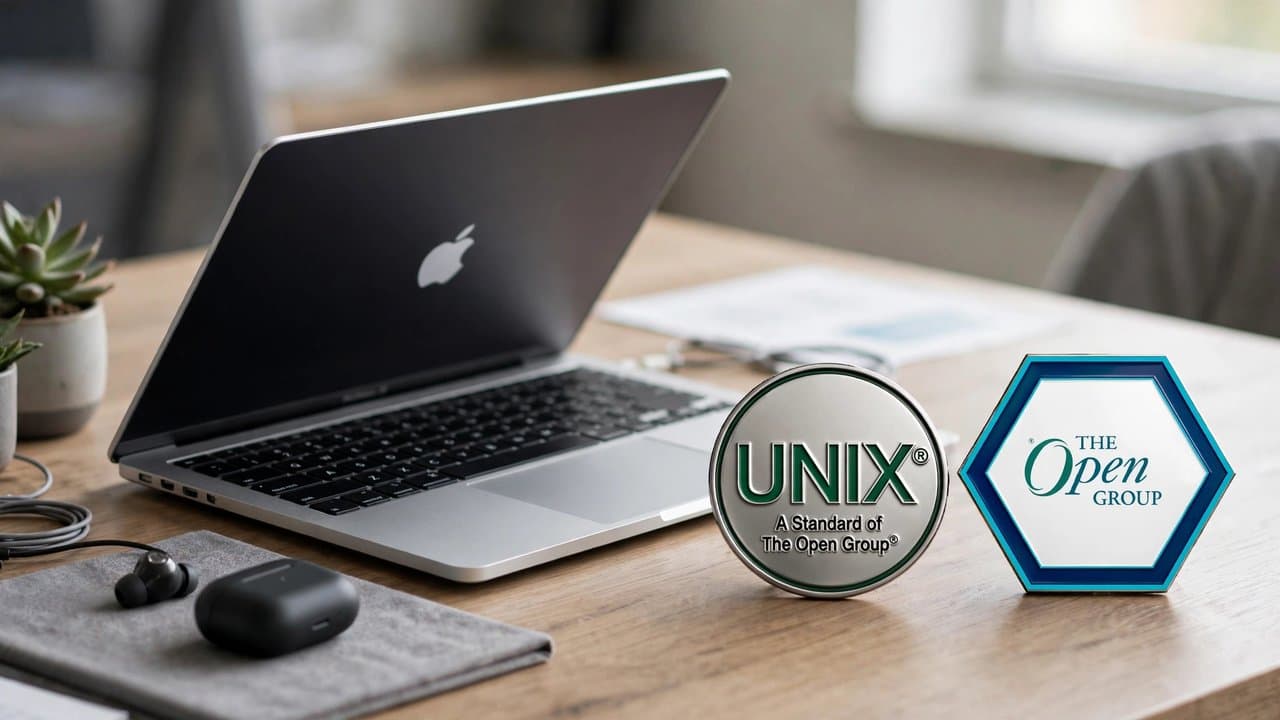
Is macOS Still a Certified UNIX? What the Registry Actually Says

Mahmud Hasan
October 11, 2026
On October 10, someone on Hacker News noticed that Apple was missing from The Open Group's official UNIX registry overview. The thread hit 187 points and 173 comments in hours, and the headline wrote itself: Apple had silently lost its UNIX certification. There's just one problem — the registry's own detail pages still list macOS Tahoe as a certified UNIX, on both Apple silicon and Intel, registered August 29, 2025.
So which is it? Neither, exactly. And the real story — what the badge actually certifies, and what you'd have to do to your own Mac to make it pass — is more interesting than either headline.
What was actually observed (and what wasn't)
The Open Group's UNIX Certified Products overview is its official register of certified products. At check, its vendor list included IBM, Hewlett Packard Enterprise, and SCO. No Apple. That's the entire observation driving the story, and it's real — one page, missing one vendor.
But the register's UNIX 03 product listing — the standard-specific page, not the summary — tells a different story. It contains two Apple entries, both named "macOS version 26.0 Tahoe." One names its environment as Apple silicon-based Mac computers; the other, Intel-based Mac computers. Both show a registration date of August 29, 2025, and both carry Brand Certificate links. The individual product records were accessible at the time of checking.
So we have an overview page that omits Apple and detail pages that include it. That's a presentation disagreement, not a revocation. No one has produced a revocation notice, a removal date, or an explanation from Apple or The Open Group. The careful claim — the one you can verify yourself — is this: Apple is absent from the overview; Tahoe remains listed under UNIX 03. Anything beyond that is a conclusion built on an unexplained omission, and it travels worse than the two checkable facts.
What "UNIX certification" actually means
Here's the part that makes the whole debate feel like arguing about a flag: "UNIX" hasn't meant code for over thirty years. When Novell bought UNIX from AT&T in 1993, the trademark was severed from the source code, and it has been a legal instrument ever since. The Open Group owns the UNIX trademark, and it rents the right to use it to vendors whose systems comply with the Single UNIX Specification (SUS).
The SUS is essentially POSIX with a trademark attached: defined C programming interfaces, a command-line shell, a set of user commands, and the X/Open Curses specification. As The Register put it, modern UNIX certification is really just "a newer name for POSIX." Your Mac doesn't run any AT&T code. Neither does IBM's z/OS — a mainframe OS descended from 1970s IBM systems, also certified — and Linux, the most-used UNIX-like system on Earth, mostly never bothered getting certified at all.
There's also a versioning detail the cheerleaders skip. macOS isn't certified against the current spec. It's certified to UNIX 03, which maps to SUS version 3 — published in 2002, last amended in 2004. The current SUS version 4 dates to 2008, rolled up in 2018. The only operating system on Earth holding the UNIX V7 trademark is IBM's AIX 7.2. Apple's certification is, in spec terms, more than twenty years stale.
And the certification is rented, not owned. It attaches to a named product on named hardware — "macOS version 26.0 Tahoe on Apple silicon-based Mac computers" — with an annual renewal cycle. Tahoe's records showed a next-renewal date of August 29, 2026. Vendor membership costs real money (Apple sits in The Open Group's silver tier, roughly $22,000 a year before certification fees). This is a subscription business with compliance paperwork, and subscriptions lapse for the most boring reasons imaginable: a stale summary page, a CMS migration, a line item that hasn't been paid yet. We don't know the cause of the overview omission. "We don't know" is the whole point.
The Mac you own isn't the Mac that passed
Now for the part that actually embarrasses the badge. Apple's conformance statements — the documents vendors file with The Open Group as part of certification — are public. Buried at the end of each one is a text field for "additional, explanatory material that was provided by the vendor," and Apple's entries are extraordinary.
To make macOS pass the UNIX 03 conformance test suite, Apple's own documents say you must: disable System Integrity Protection (boot into recovery, csrutil disable), enable the root user, enable core-file generation, disable kernel timer coalescing, mount APFS partitions with strictatime, reformat your APFS partitions as case-sensitive (the default is case-insensitive, so: reinstall), disable Spotlight, copy the uucp binaries into /usr/local/bin with the setuid bit, enable the uucp service — and absorb four "Temporary Waivers" covering implementation errors the vendor hasn't fixed yet.
For comparison, IBM's AIX — the only UNIX V7 system — ships with exactly one appendix note: change one socket listen-queue value. HP-UX and Solaris require nothing meaningful. macOS requires a checklist that dismantles half of what makes a Mac a Mac in 2026.
So the honest sentence is: the product Apple certified and the product Apple ships are different artifacts. There is very likely not a single Mac on Earth, running a stock configuration, that could pass the certification test suite it claims to hold. This isn't a scandal — nobody's certificate was forged, and no executive scheme is involved. It's evidence that the trademark measures paperwork compliance under laboratory conditions, not the machine on your desk.
Why the missing line on one page matters less than you think
For almost everyone, this story changes nothing. Your terminal doesn't check trademarks. Scripts don't consult registers. macOS's UNIX heritage — the BSD-derived userland, the XNU kernel, the POSIX shell sitting under all the Cocoa — is a technical fact that a registry page can't revoke or grant.
The badge's real audience is procurement. Contracts and compliance checklists name standards, and when they do, the useful document isn't the overview page — it's the individual product record: exact product name, exact hardware environment, registration date. That's the practical habit this whole episode should leave you with. When someone says "Apple was removed," ask which page they read, and point them at the records that complicate it. An unverified one-liner becomes team folklore fast, and folklore is a shaky foundation for procurement decisions.
And if the overview gets fixed tomorrow — a line re-added in a CMS — the deeper facts stay put: UNIX certification is a paid trademark for a 2002-era spec, attached to a lab configuration no customer ever runs. The badge was never measuring what the arguments assumed. The missing vendor line was the glitch. The real news is what the badge was certifying all along.
References
- macOS Tahoe and UNIX certification: checking the exact product record — The Daily Diff (dev.to) — overview omission vs. accessible UNIX 03 records, both checked at source
- Apple's macOS UNIX certification is a lie — OSNews — Apple's conformance-statement appendices, the UNIX 03 vs. V7 gap, membership and certification costs
- Apple macOS 15 Sequoia is officially UNIX — The Register — what UNIX certification actually means (a newer name for POSIX), Tahoe-era context
Comments
More in Technology

The AI Boom's Favorite Number Just Dropped From $70B to $50B. Wall Street Noticed.
The FT says OpenAI's annualized revenue is $50 billion, not the $70 billion investors were using. Wall Street sold tech on the difference — here's why one disputed number can sink trillions, and what to watch instead of model launches.
Read more
Bangladesh Got Satellite-to-Mobile Before India. Your 4G Phone Didn't Change — the Sky Did.
Banglalink and Starlink launched South Asia's first direct-to-cell service on October 7: your existing 4G phone and SIM can now text and share location through satellites in dead zones. Here's how the orbital cell towers work — and what they can't do yet.
Read more
Apple's New CEO Just Made Himself Its Design Chief. He's an Engineer. That's the Point.
John Ternus visits Apple's design studio several times a week — Tim Cook came about once a month. Seven years after Jony Ive left, the CEO has made himself the company's design chief, and the bet is that one decision-maker beats a committee.
Read more