
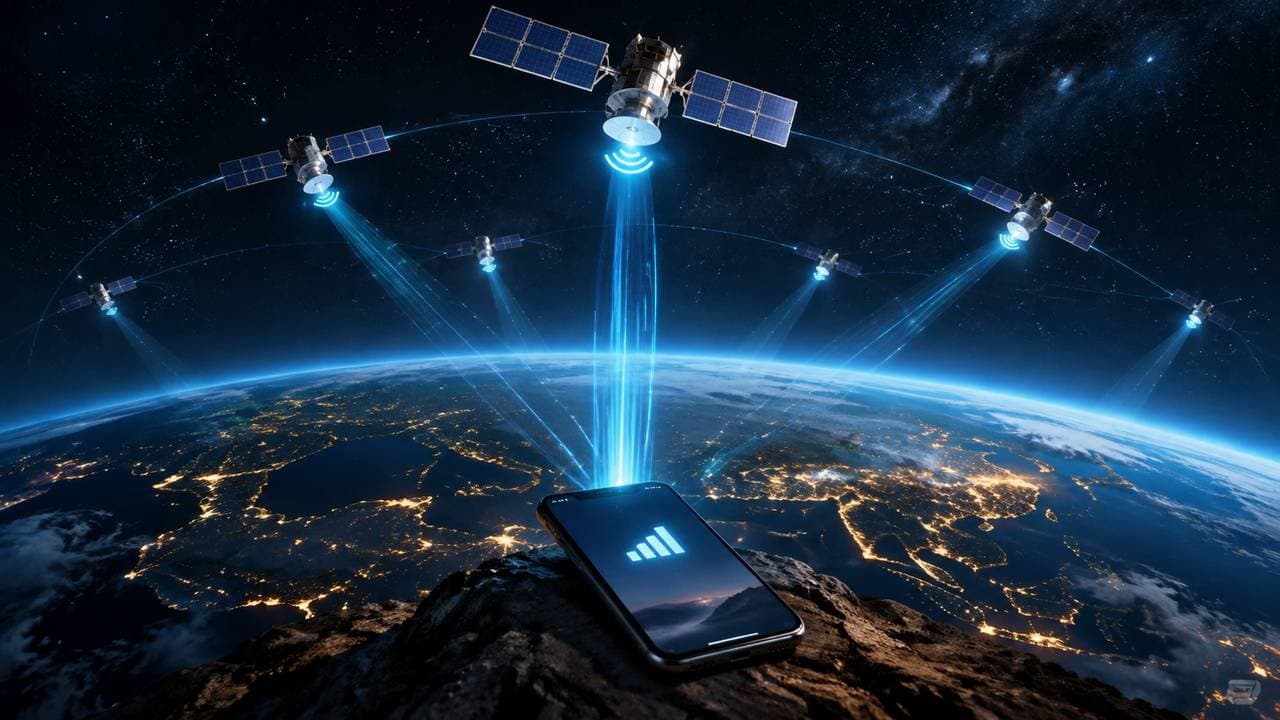
Bangladesh Got Satellite-to-Mobile Before India. Your 4G Phone Didn't Change — the Sky Did.

Mahmud Hasan
October 9, 2026
Your phone didn't change this week. The sky did. On October 7, Banglalink switched on a Starlink-powered service that lets an ordinary 4G phone text and share location where no cell tower reaches — bundled into the data pack you already buy. Here's how the orbital cell towers work, what they can't do yet, and why Bangladesh got them before India.
What actually launched
On October 7, Banglalink announced it had switched on a satellite-to-mobile service powered by Starlink, making Bangladesh the first country in South Asia to offer it. The pitch is disarmingly simple: if you have a compatible 4G phone, a Banglalink SIM, and a clear view of the sky, you can send messages and share your location in places where no cell tower reaches you.
No dish. No satellite phone. No new hardware of any kind. The same phone in your pocket, the same SIM in its tray.
The service is aimed at the places terrestrial networks have never covered well: fishermen out at sea, travelers in the hill tracts, coastal communities, and deep-sea locations inside Bangladesh's exclusive economic zone. It's also positioned as a resilience layer — connectivity that survives cyclones, floods, and the prolonged power outages that knock towers offline. Customers can use essential apps and location services over the satellite link whenever they're outside conventional coverage.
Pricing is deliberately frictionless. Banglalink is offering Starlink connectivity free with any internet or mixed bundle pack during the first month. From the second month, it continues at no extra cost with selected monthly internet and mixed bundle packs, plus five free SMS messages each month over the satellite network.
That pricing matters. A separate satellite plan would be a niche product for seafarers and expedition teams. Bundled into ordinary monthly packs, it becomes an insurance policy riding along on the plan you already buy. The message from Banglalink CEO Johan Buse's launch statement was exactly that — connectivity is about a family hearing from a loved one, a fisherman sending a message home. Distance shouldn't mean disconnection.
How a phone talks to a satellite 550 kilometers up
The trick is that the satellite is not acting like a satellite. Each of Starlink's direct-to-cell spacecraft carries a payload that functions as an orbital LTE base station — an eNodeB, in cellular terminology. To your phone, the satellite overhead looks like a very distant cell tower, and your phone's existing LTE radio handles the connection the way it always does. When no terrestrial tower is reachable, the phone latches onto whichever direct-to-cell satellite is visible, over the operator's licensed spectrum.
The hard part is physics. A normal cell tower is a few hundred meters away and transmits at tens of watts. A Starlink satellite is roughly 550 kilometers overhead, and your phone transmits at less than a quarter of a watt. The signal arriving at the satellite is extraordinarily faint.
SpaceX closes that link budget with enormous antennas. Each direct-to-cell satellite carries a phased-array antenna of roughly 25 square meters — a dinner-table-sized array in orbit — that forms narrow beams concentrating the satellite's receiving sensitivity on small patches of ground. Instead of one big cell, the satellite paints moving cells a few tens of kilometers across that sweep over the surface as it orbits. SpaceX has deployed more than 650 of these satellites, forming one of the largest space-based LTE networks in existence.
None of this requires a firmware update for basic messaging on most recent phones, and no special app. The operator keeps its spectrum license, its core network, and its billing; the satellite is, effectively, a tower the operator didn't have to build. Building a new terrestrial tower typically takes 18 to 24 months. A constellation in orbit skips the land acquisition, the permitting, and the grid connection entirely.
The catch: this generation is narrowband
Here's the honest version, because the launch headlines make this sound like broadband from space: it isn't. The current commercial direct-to-cell service is narrowband — text messaging, light messaging-app traffic like WhatsApp texts, location sharing. No voice calls, no video, no general web browsing, no streaming. If you were hoping to load your feed from the middle of the Bay of Bengal, that's not this generation's job.
That limitation is a consequence of the link budget, not a business decision. Getting a phone's whisper of a signal 550 kilometers up only works for low-throughput communication that tolerates delays, interruptions, and constant handoffs between fast-moving satellites. Everything about the system is designed around tiny packets that can survive a fragile link.
Higher throughput is a roadmap item, not a launch feature. SpaceX's next-generation satellites aim for roughly 20 times the throughput of the first generation, using custom silicon and more advanced beam-forming, and voice capabilities are on that roadmap too. But the service shipping today is a lifeline product: texts, pings, locations. Treat it as a safety net layered over your regular coverage, not a replacement for it.
Why Bangladesh beat India
The part of this story that will travel fastest isn't the technology — it's the map. Elon Musk himself announced the launch on X on October 8, posting that millions of Banglalink customers could now "message over apps, share location and stay connected on compatible phones in cellular dead zones."
Meanwhile, next door, Starlink is still waiting. In India, the company's satellite services remain stuck in licensing limbo: security compliance reviews are ongoing and spectrum assignment is pending, with the government insisting that services meet its security requirements for user data. Neither the dish-based broadband nor a mobile partnership is commercially available in India yet.
The contrast has teeth because Musk has been publicly feuding with India's telecom establishment, accusing "certain oligarchs" of a "monopolistic chokehold" on the country's telecom sector — a claim that drew a sharp government response. His recent line that Starlink in India would bring "high-speed, affordable Internet connectivity for those who can't afford current prices or who don't have a connection at all" reads, in this light, as both pitch and pressure.
Bangladesh, by contrast, moved fast. Starlink received its operating license from the Bangladesh Telecommunication Regulatory Commission in April 2025 and launched dish-based service the following month. The BTRC reported 3,469 dish subscribers as of January 2026 — a modest number that explains why this mobile partnership is the more interesting bet. Dish broadband in Bangladesh was a premium niche. Bundled satellite-to-mobile, free with ordinary data packs, is a mass-market distribution strategy wearing a connectivity story.
That's the real play here. The first country in South Asia to ship this isn't the one with the biggest market — it's the one whose regulator cleared the path first, and whose carrier figured out that the winning price for satellite connectivity is "included."
What to do with this
If you're a Banglalink customer who works or travels outside tower coverage — offshore, in the hill tracts, in cyclone-prone coastal districts — this is worth switching on when it appears on your account. It's free with your bundle, and the entire point is the day you need it once.
Everyone else should read it as a signal. Direct-to-cell is the first satellite product that doesn't ask you to buy satellite hardware or change carriers. The carriers that figure out bundling fastest will own the dead zones; the regulators that clear spectrum fastest will get there first. Bangladesh just proved both points in one launch.
References
- Banglalink launches Starlink-powered satellite-to-mobile service — Prothom Alo (English)
- Bangladesh gets Starlink Mobile before India — The Week
- Banglalink launches Starlink-powered satellite-to-mobile service — The Business Standard
- Towers in the Sky: what direct-to-cell really means for mobile — technical explainer
- Starlink to trial Direct-to-Cell in Malaysia — SoyaCincau (tech explainer)
- Starlink Direct to Cell deep-dive: link budget and constellation — Keeptrack
Comments
More in Technology
Apple's New CEO Just Made Himself Its Design Chief. He's an Engineer. That's the Point.
John Ternus visits Apple's design studio several times a week — Tim Cook came about once a month. Seven years after Jony Ive left, the CEO has made himself the company's design chief, and the bet is that one decision-maker beats a committee.
Read more
California Banned Robo Bosses. Your Performance Dashboard Survived.
On September 30, California became the first state to ban AI-only firings. The law has real teeth — but it doesn't touch the surveillance software scoring you every day. Here's the fine print.
Read more
1 in 8 Cancers Starts as an Infection. A Significant Share Is Preventable — We Are Just Not Acting.
A new IARC study published in The Lancet Oncology says 2.3 million cancers diagnosed in 2024 — one in eight — were caused by infections. Unlike the genetics story, most of these are preventable with vaccines, antibiotics, and screening we already have.
Read more