
Huawei's New Chip Folds Transistors in 3D — Because Sanctions Won't Let Them Shrink

Mahmud Hasan
October 3, 2026
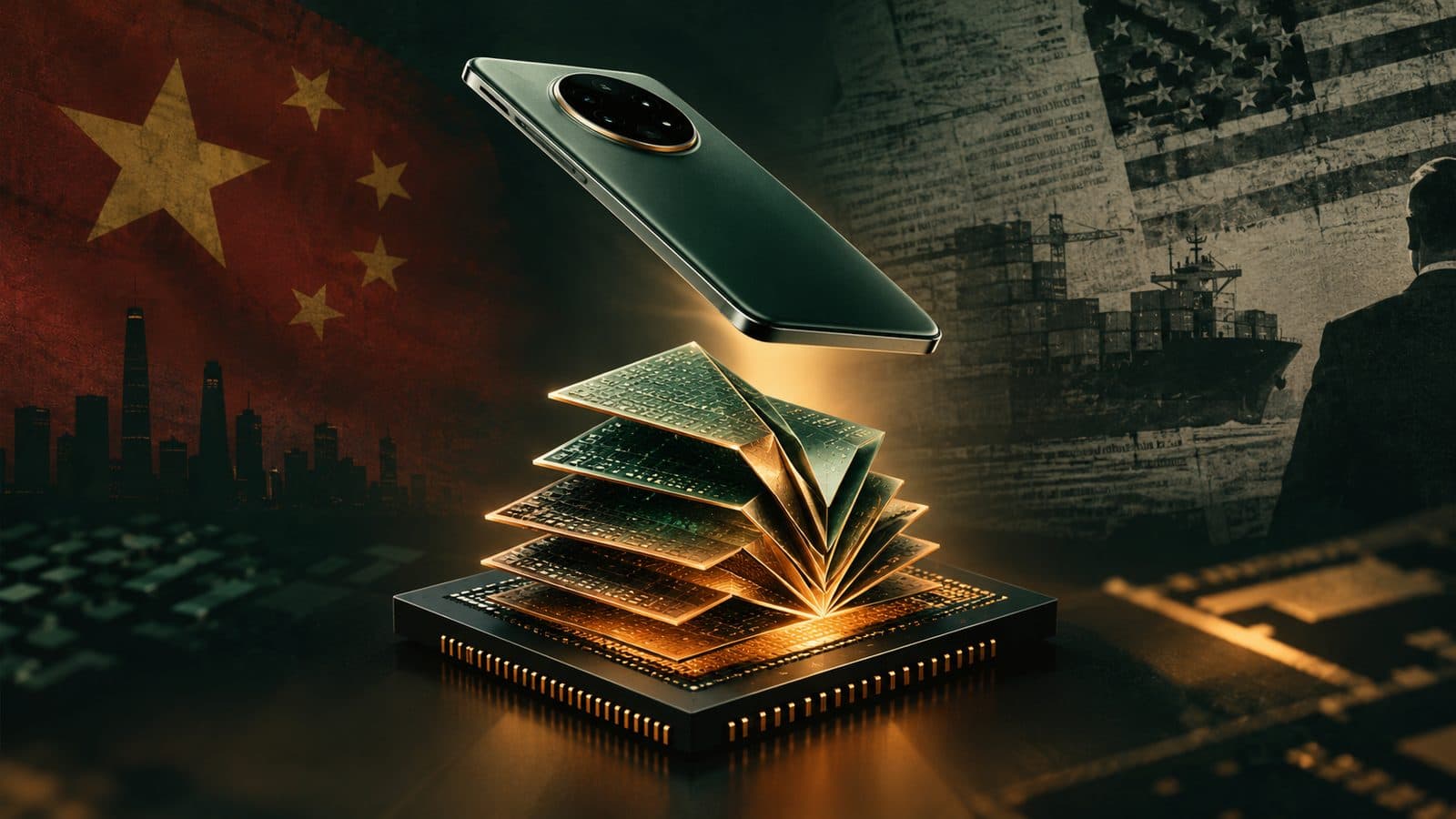
On October 1, Huawei launched the Mate 90 — and the phone itself was the least interesting part. Buried in the launch material was a chip with a new name: the Kirin 9050 Pro, billed as the world's first processor built on something Huawei calls LogicFolding.
Here's the short version: the US cut Huawei off from the machines that make modern chips smaller, so Huawei started making them differently shaped instead. The wiring inside the transistor layer now folds in three dimensions, squeezing more performance out of silicon that — by any honest lithography measure — shouldn't be this fast.
It's part press release, part physics, and part geopolitics. Let's untangle it.
Why Huawei can't just shrink its chips
Every chipmaker on earth knows the same playbook: smaller transistors, shorter distances, faster chips. The trouble is that the machines that draw those tiny features — extreme ultraviolet (EUV) lithography scanners, built by exactly one Dutch company, ASML — are off-limits to China under US export controls.
Huawei's chips are believed to be manufactured by SMIC, China's top logic foundry (Huawei doesn't disclose the foundry, and SMIC doesn't comment), using deep ultraviolet (DUV) lithography — the older generation of equipment. Richard Yu, Huawei's consumer chief, said at the launch that China's advanced chipmaking still relies on DUV, and that while EUV is "valuable," Chinese manufacturers are still working toward it.
You can't wish your way past physics. So Huawei attacked a different bottleneck.
LogicFolding: if you can't shrink, fold
Here's the genuinely clever part. On a chip, the transistor itself is only half the story — the other half is the wiring connecting transistors together. As chips got denser, engineers discovered that the wires themselves were becoming the problem: longer paths mean more resistance and capacitance, which means more delay and more wasted power. The industry term is RC delay, and on modern chips, it can matter more than how fast the transistors switch.
Huawei's answer, as described in its semiconductor roadmap and reported by Reuters, is a circuit-level 3D rewiring of the logic layer — shortening critical-path wiring and cutting resistive and capacitive loads instead of relying on smaller geometry. The company calls the broader framework "τ-scaling" (tau scaling): improving devices, circuits, chips, and systems together, with LogicFolding attacking interconnect distance and signal delay specifically.
It's not a marketing fantasy. This is the same physical problem the rest of the industry is throwing money at from other directions: chiplet packaging, 3D stacking, co-packaged optics. Huawei's version just skips the step where you need a €150 million EUV scanner. And according to Yu, more chips built with the LogicFolding technique are coming to future smartphones.
How fast is it, actually?
Vendor benchmarks always deserve a raised eyebrow, so treat the following as Huawei's numbers, not independent verification:
- 31% overall performance increase over the Mate 80 generation, per Huawei's launch materials reported by Reuters.
- The Kirin 9050 Pro beats Apple's A17 Pro in Geekbench 6 multicore — a meaningful result for a chip built without EUV — but trails the A20 Pro by roughly 30% in single-core, per reporting on the launch.
- The top Mate 90 Pro Max adds hardware-level ray tracing, per Huawei's launch video.
Beating Apple's 2023 chip while being built on constrained equipment is genuinely impressive. Trailing Apple's current chip by 30% is also honest context: this is Huawei catching up, not lapping the field. The company doesn't publish die sizes or power figures with the precision enthusiasts want, so the independent teardown community will have the final word — and the last few Kirin generations all got one, within weeks.
The part buyers will actually feel: prices are going up
The chip story is fun for engineers. The price story is what hits your wallet.
Memory prices have been climbing across the industry, and Yu put a number on it: rising memory costs have added an average of $200 to the manufacturing cost of each handset, badly hurting Huawei's margins. "We have to increase prices as well, yet at a slower pace," he said.
The numbers tell it plainly. The Mate 90 Pro Max with 16GB of memory and 512GB of storage is priced at ¥9,999 (about $1,491) — 2,000 yuan more than the equivalent Mate 80 at launch. The standard Mate 90 starts at ¥5,999, the Pro at ¥6,999. This isn't a Huawei-only phenomenon: the average selling price of smartphones in China climbed 11.3% year-on-year in Q2 to $543, according to IDC. But Huawei's own average price fell 14.7% to $628 — meaning the company has been absorbing costs competitors are passing on, and that era is visibly ending.
China is buying it anyway
Here's the number that matters most to anyone trying to understand whether export controls are "working": Huawei held 23% of the Chinese smartphone market in Q2 2026, up from 14% in Q4 2025. China's overall shipments fell 7% year-on-year from January to August — and Huawei's rose 13% (IDC).
The previous Mate 80 sold over a million units in its first month, and analysts expect the Mate 90 to top it. HarmonyOS — Huawei's Android-free operating system — now accounts for 24% of Chinese smartphone sales. The company says HarmonyOS 7 supports more than 450,000 apps and services, and that 85 million devices already run HarmonyOS 6 or 7, with the broader OpenHarmony ecosystem past 1.3 billion devices.
Meanwhile the foldable war is heating up. Apple announced its first foldable, the iPhone Duo, last month. Yu said he was "very pleased to see the launch of a similar product by our peers" — and the numbers back his confidence: Huawei holds roughly 75% of China's foldable market, and Pura X Max shipments jumped 76% week-on-week right after Apple's announcement, topping 1.2 million units since April. Counterpoint expects Apple to ship six million iPhone Duos in 2026, with China taking nearly a quarter. That's the first real fight Huawei has had in this category.
Why this story matters more than one phone
The Mate 90 is a China-market phone — no Google services, no confirmed Western launch, no pricing outside China. If you live outside China, this is a spectator sport.
But the LogicFolding philosophy is the story to watch. Export controls were supposed to freeze Huawei's silicon progress. Instead, Huawei rerouted: the same company already shipped the Ascend AI chips that, as analysts noted at the time, moved faster than export controls anticipated. If a folded-logic technique that works on a phone chip scales to server-grade AI silicon — and Huawei has already framed τ-scaling as relevant to AI computing — then the controls are slowing a clock, not stopping it.
There's honest skepticism to keep: vendor benchmarks, no independent die data yet, and a 30% gap to Apple's best is still a gap. But the direction of travel is clear. In 2023, Huawei shocked the industry with the Mate 60's 7nm chip. In 2026, it's shipping the first LogicFolding chip and telling investors more are coming. The sanctions playbook assumed that without better machines, progress stalls. Huawei is now running the experiment that tests that assumption — one folded transistor at a time.
References
- Reuters, "Huawei unveils Mate 90 phones, leans on homegrown chip design to offset US curbs," October 1, 2026 — reuters.com
- Gagadget, "Huawei Mate 90: big cameras, home-brew chips, and no plans for the West" — gagadget.com
- BitcoinVersus, "Huawei Puts LogicFolding Chip Architecture Into Mate 90," October 1, 2026 — bitcoinversus.tech
- InformaXPrime, "Huawei Mate 90 Launches With Kirin 9050 Pro and HarmonyOS 7," October 1, 2026 — informaxprime.com
Comments
More in Technology

Google Just Put Four AI Chips in Orbit. The Hard Part Isn't Getting There.
Project Suncatcher's first satellite launched October 1 with four Trillium TPUs — and Google's own peer-reviewed Joule paper says orbital data centers need launch costs at $200/kg and 1,800 Starship launches to make economic sense.
Read more
PixelLeak: Your Coding Agent Solved the Screenshot Problem by Making It Public
AI coding agents posted 13,000+ internal screenshots — billing records, treasury consoles, unreleased features — to public GitHub repos. Nobody hacked anyone. Here is how it happened, and what your team should do this week.
Read more
Pi 1.0 Hit #1 on Hacker News. The MCP Surrender Isn't the Interesting Part.
Pi 1.0 topped Hacker News this week -- the coding agent that once swore off MCP finally shipped MCP support. The surrender is less interesting than the architecture that made it possible.
Read more