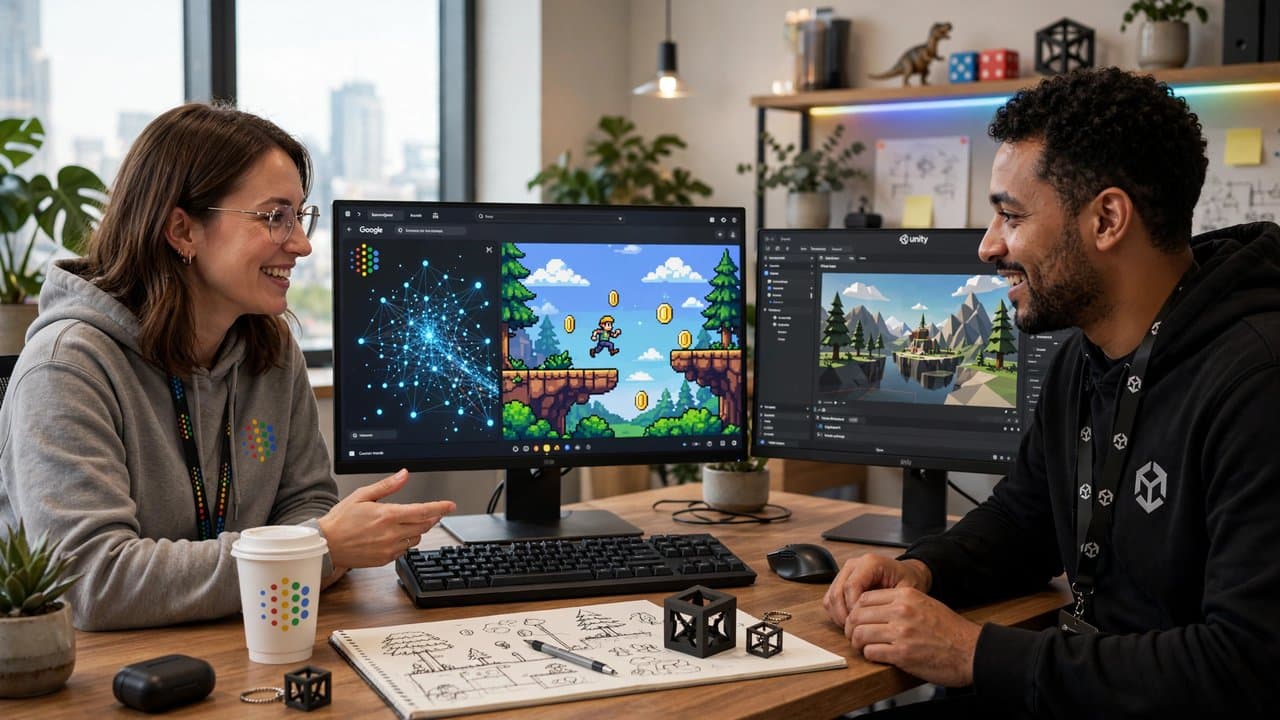
In March, Google's AI Tanked Unity's Stock 22%. This Week They're Building Games Together.

Mahmud Hasan
October 11, 2026
In March, Google showed off an AI that could generate entire game worlds on the fly, and Unity's stock cratered 22% in a single day. On October 7, the two companies announced they're building AI games together. The flip isn't charity — it's a two-front attack on Roblox, and it lowers the price of making a game from a game engine to a sentence.
What actually shipped on October 7
Google's half is Playground, a Google Labs experiment live now at playground.google. It's browser-based — phones and laptops, no install — and limited to US users aged 18 and up. You type a description of a game, and the system generates a playable version you can test immediately, then keep refining by chatting: "make the character double jump," "change the physics so objects bounce higher."
Under the hood it's a three-model stack: Gemini for general generation, Nano Banana for images, and DeepMind's Lyria for music. You can go 2D or 3D, single-player or multiplayer for some genres, and upload your own PNG or JPG as a starting point — the AI stylizes it into game assets rather than pasting your photo in. Play Games integration brings leaderboards and a public Explore gallery. When you're done, you can keep the game private, share a link, publish to the gallery — or download a ZIP with the game's actual web code and assets, which is more control than most AI demos hand over.
The catch is the tiers: creation runs on limited weekly tokens for free, with larger quotas for Google One AI subscribers. This is a live beta with no global rollout date.
Spark enters closed beta later this year with a waitlist open now, and Spark-built games will be shareable through Playground. Unity CEO Matt Bromberg was explicit that Spark is not meant to be a single-prompt game generator: asking AI to regurgitate an already invented game "does not make you the next Hideo Kojima, any more than re-typing the first paragraph of War and Peace in your word processor makes you Tolstoy."
March's funeral, October's wedding
The backstory makes the partnership. Earlier this year, Google unveiled Project Genie — AI-generated gaming environments — and Unity investors read it as an obituary for the traditional engine business. The stock dropped 22% in one session.
Both sides had reasons to switch from adversaries to allies. Unity is growing again — Q2 2026 revenue hit $546 million, up 24% year over year, with adjusted EBITDA up 77% — but the company is still not GAAP-profitable, closing fiscal 2025 with a roughly $402.8 million net loss. A consumer AI game-maker built from scratch would be expensive, risky work; hitching the Unity runtime and Asset Store to Google's distribution reach and AI budget is a cheaper way to own the professional tier of the prompt-to-game funnel.
Google's reasons are symmetrical. Playground's prompt output is fast but shallow, and Google has no game engine, no asset marketplace, and no creator pipeline. Unity brings all three. The companies describe Spark as a bridge between Playground's instant, disposable prompts and an actual finished game — and the funnel between those two is where a platform business lives.
Wall Street bought the logic. Raymond James analyst Andrew Marok upgraded Unity to Outperform on October 8 with a $54 price target — roughly 20% above current levels. The telling part is that Marok had previously worried that easier creation through Roblox and generative AI tools could weaken Unity's creator funnel. The Google deal, in his read, fixes that by expanding Unity's reach while tightening the connection between its Create, Runtime, and advertising businesses. Consensus is still "Strong Buy," though with a mean target near $48, some analysts think the easy upside is already priced in.
The real target is Roblox
Neither Google nor Unity named Roblox in the announcement. They didn't have to. Roblox is the company that has owned user-generated gaming for two decades: 123 million daily active users, $1.469 billion in quarterly revenue as of Q2. On October 7, Unity shares jumped as much as 5% in premarket trading while Roblox fell as much as 8%. By October 9 the moves had calmed, but the message had landed.
Roblox is also fighting on other fronts. A securities class-action lawsuit publicized in mid-2026 alleges the company misled investors about its age-verification rollout, after disclosing that only 51% of global daily active users had completed verification — a disclosure that erased several billion dollars of market cap in one session. Meanwhile Roblox has been building its own escape hatch: "Roblox Everywhere," announced at its September developer conference, will let creators ship Roblox-made games as standalone apps instead of being locked to the Roblox client. And Roblox shipped its own text-prompt creation tool, Roblox Build, back in July — currently in testing, with a path into Roblox Studio and creator payouts.
Read the three strategies together and they all assume the same thing: locking creation and distribution into one walled client is a long-term liability, not a moat, in an AI-assisted content era. Epic's UEFN has been running the Fortnite-side version of this experiment for years — stripped-down Unreal tools inside Fortnite — and even with that head start it has produced few breakout hits outside Fortnite's own ecosystem. Nobody has proven that prompt-generated games can be commercially durable yet.
What's not proven (and Google knows it)
The honest case against the hype starts with quality. Early Playground testers report odd animations and a real gap between what the prompt promises and what plays: one GameSpot writer noted the generated cover art often looks far more polished than the actual gameplay — a cozy latte-catching game that moved clunkily, a steampunk puzzle that felt half-baked. A toy you can publish is still a toy.
The commercial terms are equally unresolved. Neither company has said whether Playground will carry advertising, whether Spark creators get a revenue share, or how Asset Store purchases inside Spark will be priced and split. Any specific monetization percentage you see circulating is speculation until either company publishes real terms.
The gap between Google's cautious adults-only beta and the actual market is where the interesting problems will show up.
What to actually do with this
If you're in the US and 18 or older: go try playground.google this week. The useful move is not "make a game" but "prototype a game idea in ten minutes" — describe a mechanic you've been turning over, iterate in conversation, and see where it breaks. The ZIP export is the interesting part: real web code to inspect, which makes Playground a prototyping tool rather than a demo.
If you're outside the US: join the Unity Spark waitlist and watch the closed beta. Spark is the part of this story that matters to people who actually finish games — real runtime, real assets, real collaboration — and its beta will reveal whether "human taste plus AI starting point" is a workflow or a slogan.
The structural takeaway is the flip. Six months ago, Google's AI game tech was Unity's worst day of the year. This week it's Unity's distribution partner. When a vendor stops fighting the technology that threatened it and starts selling the shovels for it, that's usually the moment the technology gets real.
References
- Tech Insider — Unity Spark vs Roblox: Google AI Game Deal Lifts Stock (Oct 10, 2026)
- Barchart — Analyst Just Upgraded Unity Stock. Here's Why. (Oct 8, 2026)
- WebProNews — Google's Playground: AI Lets Anyone Build Browser Games With a Few Typed Words
- TalkEsport — Google Playground: Make Games With AI Prompts, No Code
- WinBuzzer — New Google Playground Turns Prompts Into Shareable Games
- BigGo Finance — Google and Unity Team Up on AI Game Creation, Sending Roblox Shares Tumbling
Comments
More in Technology

Is macOS Still a Certified UNIX? What the Registry Actually Says
HN noticed Apple missing from The Open Group's UNIX registry overview — but the register's own detail pages still list macOS Tahoe as certified. Here's what the badge actually means, and why your Mac never ran the version that passed the test.
Read more