
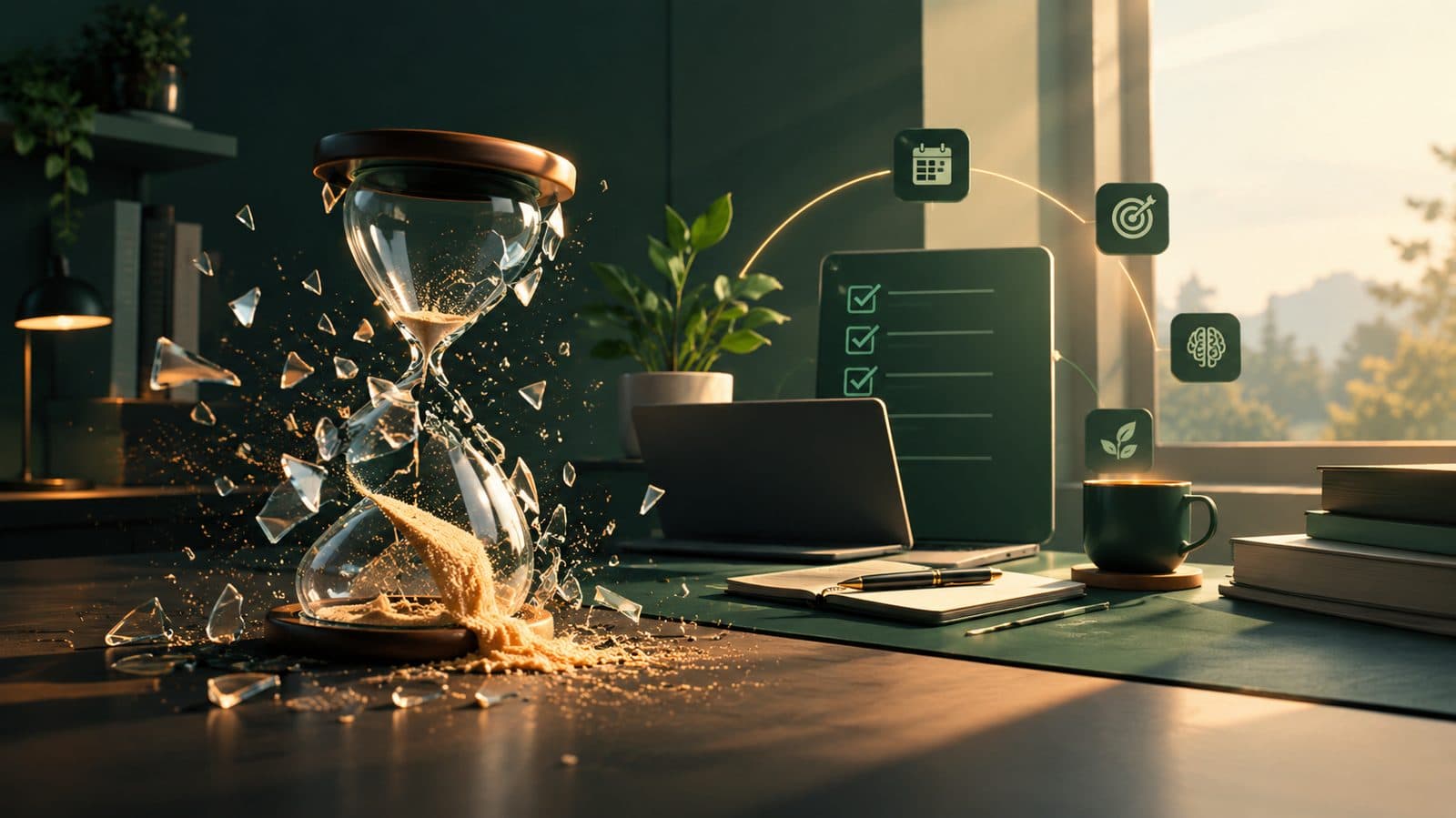
The 23-Minute Focus Statistic Isn't Real. The Damage Still Is.

Mahmud Hasan
October 4, 2026
The most famous focus statistic is made up
You've seen the number. It's in keynote slides, productivity books, and a thousand blog posts: an interruption costs you 23 minutes and 15 seconds of refocus time. Precise to the second. Science-y enough to repeat without checking.
Here's the problem: there is no peer-reviewed paper behind it. The figure traces back to an unpublished 2006 Gallup interview with Gloria Mark, the UC Irvine researcher whose work gets cited for it. Someone heard the number, wrote it down, and two decades of productivity advice built on top of it. I only know this because I went looking for the original study this week and kept not finding it — until I found researchers who'd gone looking too, and documented the dead end.
So let's start over with what Mark and others actually published, because the real story is more interesting than the slogan — and it explains why "just try harder" has never worked for you.
What interruption actually costs you
The stat everyone quotes gets the mechanism wrong. In an experiment run by Mark and colleagues at UC Irvine and Humboldt University, interrupted participants didn't do worse work. They did it faster, with no measurable drop in quality. People compensate.
The compensation showed up somewhere else: the interrupted group reported higher stress, more frustration, greater time pressure, and more effort. The bill for interruption doesn't always land on the dashboard. It lands on you, later, as exhaustion.
This reframes everything. Anyone who's had a "productive" day — tickets closed, emails answered — and still felt wrung out by 6 PM knows exactly what this feels like. You didn't fail at focus. You paid the focus tax in a currency nobody tracks.
And the hits are smaller and more frequent than we admit. A 2026 study by Fournier and colleagues, published in Computers in Human Behavior, found that a single notification hijacks cognitive processing for about seven seconds — even if you never check it. Their participants received roughly 150 notifications a day, checked their phones about 100 times, and spent around seven hours on their phones. The disruption was worse when the alert felt personally relevant. Your brain doesn't just get interrupted; it gets auditioned, a hundred times a day, for things that don't matter.
One nuance worth keeping: a little interruption isn't the enemy of everything — some research suggests moderate breaks can help divergent, creative thinking (Khalaf et al., 2022). Which is exactly why the fix is protected focus blocks, not a monastery.
Your brain was never going to win this fight
Part of the problem is that switching isn't free even when it looks clean. Sophie Leroy, a business school professor at the University of Washington, named it attention residue: when you switch tasks, part of your attention stays stuck on the previous one. The more engaging the interrupted task, the bigger the residue. Her finding was blunt — people who finish one thing before moving to the next perform significantly better than people who switch mid-task.
Worse: the enemy is mostly you. Mark's two decades of field studies — measured with background computer logging, not self-report — show that people interrupt themselves more often than anyone else interrupts them. Average screen attention fell from about 2.5 minutes in 2004 to 75 seconds in 2012 to 47 seconds from 2016 onward. That's not a phone problem. That's an internalized twitch.
And "I'll just ignore it" doesn't work either. A Florida State University study by Stothart, Mitchum and Yehnert put people through an attention-demanding task while their phones buzzed nearby. Even participants who never touched their phones performed significantly worse — the researchers reported they were three times more likely to make mistakes, a distraction level comparable to actually answering a call. Ignoring the notification, they concluded, is not enough. It has to not arrive.
What actually works: the system
If willpower loses to physics, stop betting on willpower. Cal Newport's deep-work framework — still the most cited playbook, now refined into his Slow Productivity thinking — is really four environmental changes wearing a trench coat:
- One rhythmic deep-work block. Ninety minutes, same time every day, non-negotiable. Start with 60 if 90 sounds fictional. The rule: where you'll work, how long, what the rules are (no internet, no phone), and what you'll have ready. A ritual removes the daily decision, and the decision was the leak.
- Drain the shallows. You can't delete email and meetings, but you can confine them. Check email twice a day — 11 AM and 4 PM is Newport's classic. Batch shallow tasks into one block. Ask of every recurring commitment: how long would it take to train a smart graduate to do this? If the answer is weeks, it's shallow, and shallow gets contained.
- Quarantine the phone. Not face-down on the desk — in another room. The research above is unambiguous: proximity is the mechanism. Schedule internet windows if your work allows it; three hours a day of "no internet unless intentional" retrains the reflex faster than any app blocker.
- Embrace boredom. Newport's strangest and most important rule. If you fill every idle moment — queues, walks, the kettle boiling — with your phone, you train your brain to demand novelty on a 47-second cycle. Take distraction breaks instead of focus breaks: focus is the default state, scrolling is the scheduled exception. A 30-day audit of every app that asks for your attention usually ends with most of them deleted.
Two honest additions from newer research. First, team norms beat solo hacks: visible calendar blocks labeled "deep work," no-meeting windows, and agreed response-time expectations protect focus better than any personal system, because most interruptions are social, not technical. Second, Newport's later principle — do fewer things — is the one nobody wants to hear. A system that defends four priorities works. A system defending fourteen is a wish.
Start with exactly one change
Don't adopt the whole system. That's the same willpower bet that just failed. Pick one: the 90-minute block, same time tomorrow, phone in another room. Defend it for a week and count your deep-work hours, not your closed tickets. Most people discover they were getting two to three hours of real focus a day — and that the goal was never more hours. It was fewer taxes.
The "23 minutes" number was always a story. The good news is the true story is more hopeful: the problem was never your character. It was your defaults. Defaults can be redesigned.
References
- Research notes documenting that the "23 minutes 15 seconds" figure traces to an unpublished 2006 Gallup interview, not a peer-reviewed paper
- Gloria Mark's attention research summarized: 47-second screen attention, self-interruption, ~25-minute return times (Attention Span, 2023)
- Mark et al. interruption experiment: interrupted workers finished faster with no quality drop — but higher stress and frustration
- Fournier et al. (2026), Computers in Human Behavior: a single notification hijacks focus for ~7 seconds
- Fournier et al. (2026) details: 150 notifications/day, relevance and volume effects (Economic Times)
- Stothart, Mitchum & Yehnert (Florida State): unanswered notifications tripled error rates on attention tasks
- Frontiers in Psychology (2026): notification interruption cycles and 15–20 minute recovery (Liu et al., 2021)
- Cal Newport's four rules applied in 2026: rhythmic deep work, scheduled internet, drain the shallows, fixed-schedule productivity
- Deep work time blocking in 2026: 60–90 minutes for cognitive depth, team-level norms over solo hacks
Comments
More in Life & Productivity

Your BIG-IP's OAuth Server Has a 9.8 Hole, and Hiding the Admin UI Won't Help
A 9.8 unauthenticated RCE on F5 BIG-IP's OAuth path is under active attack — and hiding the admin UI won't help. Here's the configuration check that decides your week.
Read more
WhatsApp's New Parental Controls Watch the Groups, Not the Messages
WhatsApp's optional teen parental controls give parents a PIN-protected dashboard over group activity, privacy, and Meta AI — while end-to-end encryption stays untouched. The design tradeoff, and the opt-in problem.
Read more
Python 3.15 Ships This Friday. Here's What Actually Matters.
Python 3.15.0 lands October 9 with explicit lazy imports, a built-in frozendict, UTF-8 as the default encoding, and a faster JIT. The headline features are nice — but one quiet behavior change deserves your attention first.
Read more