
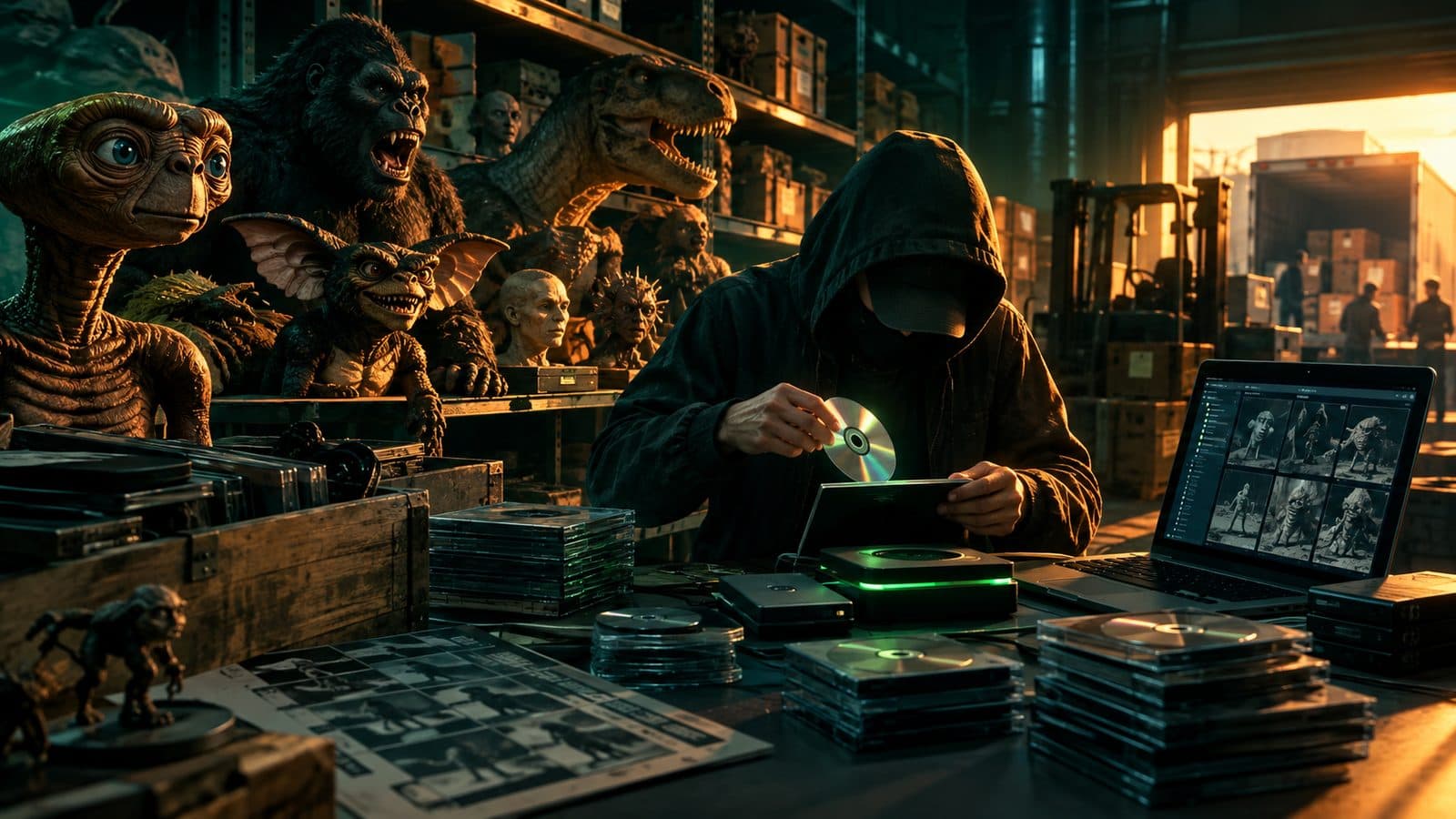
Hollywood's Creature History Was Almost Lost. An Anonymous Fan With a Disc Binder Saved It.

Mahmud Hasan
October 6, 2026
Last week, the most complete public archive of practical-effects history appeared on the Internet Archive — and it didn't come from a studio, a museum, or a film guild. It came from an anonymous fan who bought a folder of CD-ROMs at a liquidation sale.
Ninety discs from the working archives of Phil Tippett — the man whose creatures populated Star Wars, RoboCop, and Jurassic Park — digitized into ISO files and put online for anyone to download. It's the best film-preservation story of the year. It also shouldn't have been necessary.
How a disc binder ended up on the Internet Archive
Phil Tippett is one of the defining figures of practical effects. A disciple of Ray Harryhausen, his stop-motion work brought the Dejarik chess set and the cantina creatures to life in Star Wars, built the towering ED-209 for RoboCop, and provided the maquettes the Jurassic Park team used as the basis for its CG dinosaurs. Later came the bugs of Starship Troopers (he directed the sequel himself), plus work on The Matrix, Hellboy, Evolution, and Constantine.
In August, the Berkeley physical office of Tippett Studio was sold off — the culmination of the 2024 bankruptcy of the studio's U.S. entity — and decades of props, memorabilia, and art went under the hammer in a two-day auction. An anonymous attendee, later calling themselves "TippettFan," spotted a folder of CD-ROMs and DVDs among the lots and bought it for an undisclosed sum. As they wrote in the upload notes: "I quickly realized that some of this information wasn't available online and might not ever be in the future in such high resolution. So I purchased the disc folder and digitized all of its contents."
Game developer Brandon Sheffield surfaced the upload on Bluesky on October 1st, calling the buyer "an anonymous hero." It hit the front page of Hacker News on October 5th, and Kotaku followed the same day.
What's actually on the discs
The file names read like a tour of creature-making history: behind-the-scenes images from RoboCop and Starship Troopers, slides of Tippett's work on the original Star Wars, test footage of CGI creatures, a 2008 interview with Tippett himself — and, in a detail that makes the collection feel human rather than curated, publicity stills from Catwoman, the 2004 film nobody defends.
The uploader marked the especially interesting discs with !! at the start of the filename. The Internet Archive derived some preview videos — the first is a good visual overview of Tippett's influences and key work — but the bulk of the collection is raw ISO images, gigabytes of them, to download and comb through. Film historians and fans will be at this for weeks.
Not everything made it. Some discs were unreadable. Some weren't uploaded because they contained "final production" versions of films. And the uploader was careful about the personal line: "No personal info is included afaik." That restraint is what separates an archivist from a leaker.
This is the good stuff, and it's the good stuff precisely because studios almost never release it. Finished films get preserved — they're assets. But test footage, maquettes, internal slide libraries, the record of how the creatures were actually built? That's process, and process is treated as overhead. Which is why, when the building closes, it gets sold by weight.
One correction: the studio isn't actually dead
The honest version of this story needs a correction, because in September Tippett Studio issued a statement pushing back on closure reports: the Berkeley facility really is closing, but the studio continues operating, with its Toronto studio in active production on a large feature film, and stop-motion remaining part of its capabilities. The Berkeley closure was real; the death of the company was not.
So the accurate story is a stranger one: a forty-year workplace was dismantled, decades of irreplaceable working material were priced as miscellaneous media assets in a liquidation sale, and one copy — one fan's disc binder — is now the public record of it. The studio lives; its archive was still almost lost.
There's also a copyright question nobody has resolved. The discs were bought legally at auction, and then their contents were published. Studios have taken action over less. As one of the week's write-ups put it, the smart move is to browse the collection now rather than assume it will stay up indefinitely. Grey-area uploads live at the sufferance of everyone involved.
Fans do the archiving. Institutions almost never do.
The pattern here is bigger than Tippett. Lost-media communities, game preservationists, the CD-R traders of the 2000s — the rescue keeps coming from the same place: individuals who show up with their own money and a scanner. It's always a person, never an institution, who decides something is worth keeping.
The irony is hard to miss. Hollywood spent forty years going digital, and now it's going generative. The physical craft that defined the blockbuster era — the maquettes, the puppets, the slide libraries — survives mainly as burned CD-ROMs that one person bothered to rip. A CD-R, the most fragile consumer media of the 2000s, may be the most durable form this record takes. Don't get me wrong about the fragility: many of the discs were already unreadable when the buyer got to them. The uploader raced bit rot, and mostly won.
A counterpoint, because it's owed: the uploader's anonymity cuts both ways. It protects them, but it also means there's nobody to ask about provenance or what else was in the binder. We're grateful and guessing at the same time.
What to do with this
First, go browse: the collection is at archive.org/details/tippett-archive. Start with the derived video previews, then chase the filenames that start with !!.
Second, if you make things — films, designs, games, anything with a process — archive your process yourself. Export it, keep originals, and if you can legally share it, put a copy on the Internet Archive. Nobody will do this for you. That is no longer a complaint; it's an established fact, demonstrated again this week.
Third, support the Internet Archive. It's the one institution doing this work at scale, and it stays perpetually under legal fire for the trouble.
References
- Kotaku, "Lost Star Wars Media Surface After Effects Artist's Garage Sale," October 4, 2026 — https://kotaku.com/troves-of-unseen-star-wars-material-emerge-online-after-effects-wizards-garage-sale-2000739602
- Film Stories, "Tippett Studios: In the wake of its closure, a digital archive of animated materials appears online," October 3, 2026 — https://filmstories.co.uk/news/tippett-studios-in-the-wake-of-its-closure-a-digital-archive-of-animated-materials-appears-online/
- Internet Archive, "Tippett Studios visual archive (unofficial, plz read desc!)" — https://archive.org/details/tippett-archive/
- GeekTyrant, "Phil Tippett's Studio isn't Shutting Down and the Legendary VFX Company Clarifies Its Future," September 2026 — https://geektyrant.com/news/phil-tippetts-studio-isnt-shutting-down-and-the-legendary-vfx-company-clarifies-its-future
- Clay Tribune, "Tippett Studios Closed — Anonymous Fan Buys Its Auctioned Archives and Puts Them Online," October 5, 2026 — https://claytribune.com/tippett-studios-closed-anonymous-fan-buys-its-auctioned-archives-and-puts-them-online/
- ResearchBuzz, "Tippett Studios, WordPress Accessibility Day, Social Media Community, More: Monday Afternoon ResearchBuzz," October 5, 2026 — https://researchbuzz.me/2026/10/05/tippett-studios-wordpress-accessibility-day-social-media-community-more-monday-afternoon-researchbuzz-october-5-2026/
Comments
More in Design & Creativity
The Internet Joked 'Le Chonk' Into Existence. Mistral's Trillion-Parameter Model Just Made It Real.
In June the internet invented a fake French megamodel called 'Le Chaton Fat' as a joke. Mistral just shipped a real trillion-parameter flagship nicknamed 'Le Chonk' — and its benchmark claims are more interesting than the name.
Read more
TSMC Just Hit $2.5 Trillion. Four of Every Five Stocks Didn't.
TSMC's $2.5 trillion milestone is deserved — August revenue jumped 53% and it remains the only foundry that can build the AI decade. But record indexes are masking a market where breadth is collapsing and bonds price 24-year-high rates.
Read more
Google Paused Its Open-Source Bug Bounty. AI Report Spam Is Why.
On October 1, Google stopped accepting vulnerability reports to its open-source bug bounty — because AI made filing reports nearly free while verifying them still takes a human. Intel, curl, and the Linux kernel are drowning in the same flood.
Read more