
The iPhone Duo Cracked Along Its Hinge on Launch Day. What We Actually Know

Mahmud Hasan
October 23, 2026
What happened on launch day
Apple's first foldable, the iPhone Duo, went on sale Friday morning in more than 70 countries. It starts at $1,999 for 256GB and tops out at $3,199 for the 2TB model. By the afternoon, at least one owner was walking back into an Apple Store with a screen split along the fold.
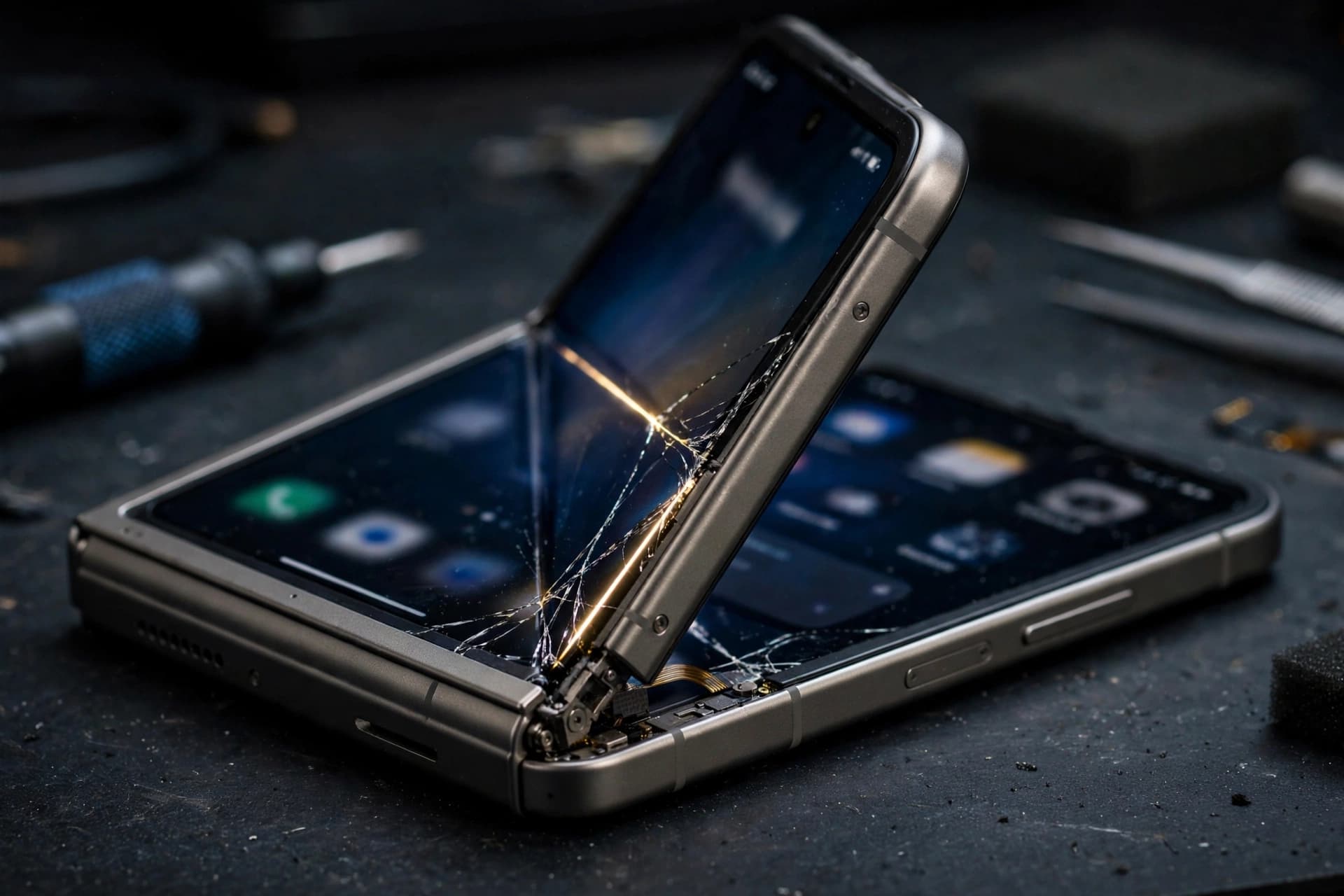
The clearest report came from an Australian buyer posting on Reddit as u/Midnight_Slump. Six hours after unboxing, fewer than 20 opens, they felt something give underneath the display near the hinge while showing the phone to a friend, then heard an audible crack. The inner screen broke right along the fold. There were no marks on the display surface or the external hinge to suggest a drop or something trapped inside.
The post drew around 1,300 upvotes and nearly 800 comments on r/iPhoneDuo. Apple support initially offered an express replacement — with the full price of the phone held on the card, no delivery date promised — so the owner walked into a physical Apple Store instead. The store swapped the unit on the spot. The lead tech called it a "day one manufacturing error," and said the broken unit would be returned to California for testing.
It wasn't the only report. MacRumors collected photos from Reddit and its own forums showing broadly similar damage: cracks concentrated along the hinge, and in several cases a line of bright pixels across one side of the screen. More surfaced from demo devices in China, which got the phone hours before the US. The confirmed cases are still a handful against millions of units in the wild, with no evidence yet of a widespread defect. Apple hasn't publicly commented.
That caveat matters. But the interesting part of this story isn't the crack count. It's everything around the cracks.
The hinge is the part that has to survive being wrong
The iPhone Duo's hinge is built from more than 100 components and exists to support the exact center of a 7.6-inch Super Retina XDR panel — the largest screen Apple has ever shipped on an iPhone. The inner display is a layered stack: a scratch-resistant coating, a nano-textured cover layer made from a custom polymer, high-strength glass above and below the folding panel, and a titanium plate underneath. The whole thing sits in a Grade 5 titanium frame with an IP68 rating, which is genuinely impressive for a foldable.
None of that makes the crease optional. A foldable's center fold is a stress concentration by definition — every open and close loads the same line of material, and the glass and polymer layers all have to survive bending to a tight radius thousands of times. When a screen fails "along the hinge" with no visible trauma, the failure is almost always in that stack: a particle, a void, or a bonding flaw that becomes the first fracture point the moment the layers flex.
This is why the store tech's "day one manufacturing error" comment rings true even without knowing the full diagnosis. Early-life hinge failures in foldables are a manufacturing-defect signature, not a design verdict. The physics doesn't need a systemic flaw — a small population of units with a bad bond in the stack will fail on the first dozen folds, and then the curve flattens.
Apple wrote the hinge-troubleshooting guide before the phones shipped
Here's the part that made me laugh, and it's documented: alongside the launch, Apple published a batch of iPhone Duo support documents. One of them is titled, in essence, "iPhone Duo Troubleshooting Hinge Issues." It tells you what to do if you're having any of the following problems with your brand-new $1,999 phone's hinge:
- Device won't open or close completely
- Unexpected noise while opening or closing the device
- Loose hinge
- Bent or broken hinge
- Enclosure damage that affects hinge operation
Every foldable launch includes care guidance; that part is standard. But there's something quietly telling about a company shipping hinge troubleshooting on day one that includes the words "bent or broken hinge." Apple knew this mechanism was the part customers would come back about. It pre-wrote the script.
Also conspicuously missing from Apple's launch materials: a fold-cycle rating. Samsung publishes one. Most foldable makers publish one. Apple's spec page says nothing about how many folds the Duo is rated for. That's the number that would turn "is my hinge okay?" from anxiety into information, and its absence means every crack report gets read against a vacuum.
Seven years ago, Samsung lived this exact week
The 2019 parallel is unavoidable because it's nearly beat-for-beat. Samsung unveiled the Galaxy Fold in February 2019, priced it at $1,980, and planned to start selling April 26. Review units broke within days — Bloomberg's Mark Gurman called his "unusable just two days in"; The Verge's Dieter Bohn found a bulge right on the crease after one day; CNBC's unit flickered and died in two. Some reviewers had peeled off a protective polymer layer that wasn't meant to be removed, but other units failed on their own. Samsung's early findings pointed to "impact on exposed areas of the hinge" and mysterious "substances" found inside devices.
Samsung delayed the launch, spent five months "refining" the device, and only put it on sale in South Korea in September 2019 — with a program covering 70% of screen-repair costs within the first year. The Fold eventually sold, the category survived, and Samsung is now on its eighth generation of book-style foldables.
That history cuts both ways for the Duo. The optimistic read: Samsung's first foldable survived far worse than a handful of early unit failures, and early-life failures were the dominant failure mode then too. The pessimistic read: Samsung had the luxury of delaying before the public got involved. Apple's failures are happening in customers' hands on day one, which is the harder version of the same story to manage.
What to do if you're holding one
If you already have an iPhone Duo: nothing in the current evidence says you should panic. The reports describe manufacturing-early failures, and the store swapped the most detailed case immediately — exactly how a manufacturing-defect signature should be handled. Hinge failures from normal use are covered under Apple's one-year warranty, and anyone who bought this week also has the standard two-week return window.
What I'd actually do, owning one: use it the way you intend to use it, soon. Manufacturing defects show up in the first weeks, and you want any crack to happen while the return window is open and Apple is actively collecting failure data — not in month eight, when the story is a repair bill instead of a swap. Keep the box.
If you're thinking about buying one: wait. Not forever. The returned units are going back to California for a reason, and whatever Apple learns from the first batch will quietly show up in the second. Every foldable has this curve; the 2019 one ended fine.
References
- Early iPhone Duo owners report screens cracking along the hinge — The Apple Post
- Crackgate? iPhone Duo Owners Report Screens Breaking Along the Hinge — MacRumors
- Apple publishes iPhone Duo support documents covering hinge, Touch ID, cases, more — 9to5Mac
- iPhone Duo screen cracks hours after launch, and the internet cries fake — PhoneArena
- iPhone Duo Owners Report Cracked Inner Screens at the Hinge — iThinkDiff
- What Most Still Seem To Miss About Apple's Historic iPhone Duo Launch — Futurum Group
- iPhone Duo: Price, Specs, Release Date & Deals — myduo.tech (all specs from Apple's published technical specifications)
- Apple unveils its first foldable smartphone iPhone Duo (AFP) — Jamaica Observer
- Why Did Apple Wait 7 Years to Make a Foldable iPhone? — Memeburn
- Samsung postpones launch of Galaxy Fold over screen breakages (2019) — Dezeen
Comments
More in Hardware & Gadgets

What Is Rendezvous and Proximity Operations? (Cosmos 2612)
What is rendezvous and proximity operations? Cosmos 2612 flew one against a US satellite, closing to 500 meters — the closest unconsented rendezvous ever seen.
Read more
Is the AI Bubble About to Burst? The Honest 2026 Answer
The IMF just put a number on the AI-bubble debate: an investment bust could shave roughly a point off global GDP by 2028. This week gave both sides fresh ammunition — here is the honest middle.
Read more
The Leap Second Is Dead: Why 69 Countries Voted to Abolish It
On October 15, 69 countries voted to abolish the leap second, effective May 2027. The real reason isn't the crashes of 2012 and 2017 — it's the negative leap second, a second that goes backward, that no computer has ever had to survive.
Read more