Flapping Airplanes Raised $1B at $6B. It Has No Product.

Mahmud Hasan
October 23, 2026
Flapping Airplanes Raised $1B at $6B. It Has No Product.
A year-old AI lab with roughly two dozen people, no product, and no revenue just raised a billion dollars. The reported valuation: six billion. The investors include Nvidia, two quant trading firms, and four of Silicon Valley's biggest venture brands. I spent today reading the coverage, the investor posts, and the skeptical engineers. Here's the honest version.
$1 billion buys a thesis, not a company
On October 21, 2026, Flapping Airplanes announced a $1 billion Series A at a reported $6 billion valuation, co-led by Index Ventures and Lux Capital. Sequoia, GV, and Kleiner Perkins came back from the seed round. Nvidia, Valor, Atreides, A*, and quant firms Jump Trading and XTX joined. Index partner Mark Xu takes a board seat.
The valuation math is the part that should make you pause. Nine months ago the company raised a $180 million seed at $1.5 billion. The valuation quadrupled with nothing shipped in between. Dealroom puts the round in the top 1% of 3,497 comparable early-stage deep-tech rounds by size.
But "no product" is not quite the right frame, because that is not what anyone is buying. The company is one of a new species: research-first labs that raise frontier-lab money before anything exists. Dealroom counts 29 of these "neolabs" founded in two years, raising a combined $23 billion. Fewer than 35% have shipped a commercial product. Safe Superintelligence is worth a reported $32 billion with about 50 people and an explicit promise to ship nothing before superintelligence arrives. The valuation is not a price on output. It is a price on the team plus the thesis. Understand the thesis and you understand the check.
The megakernel bet, in plain English
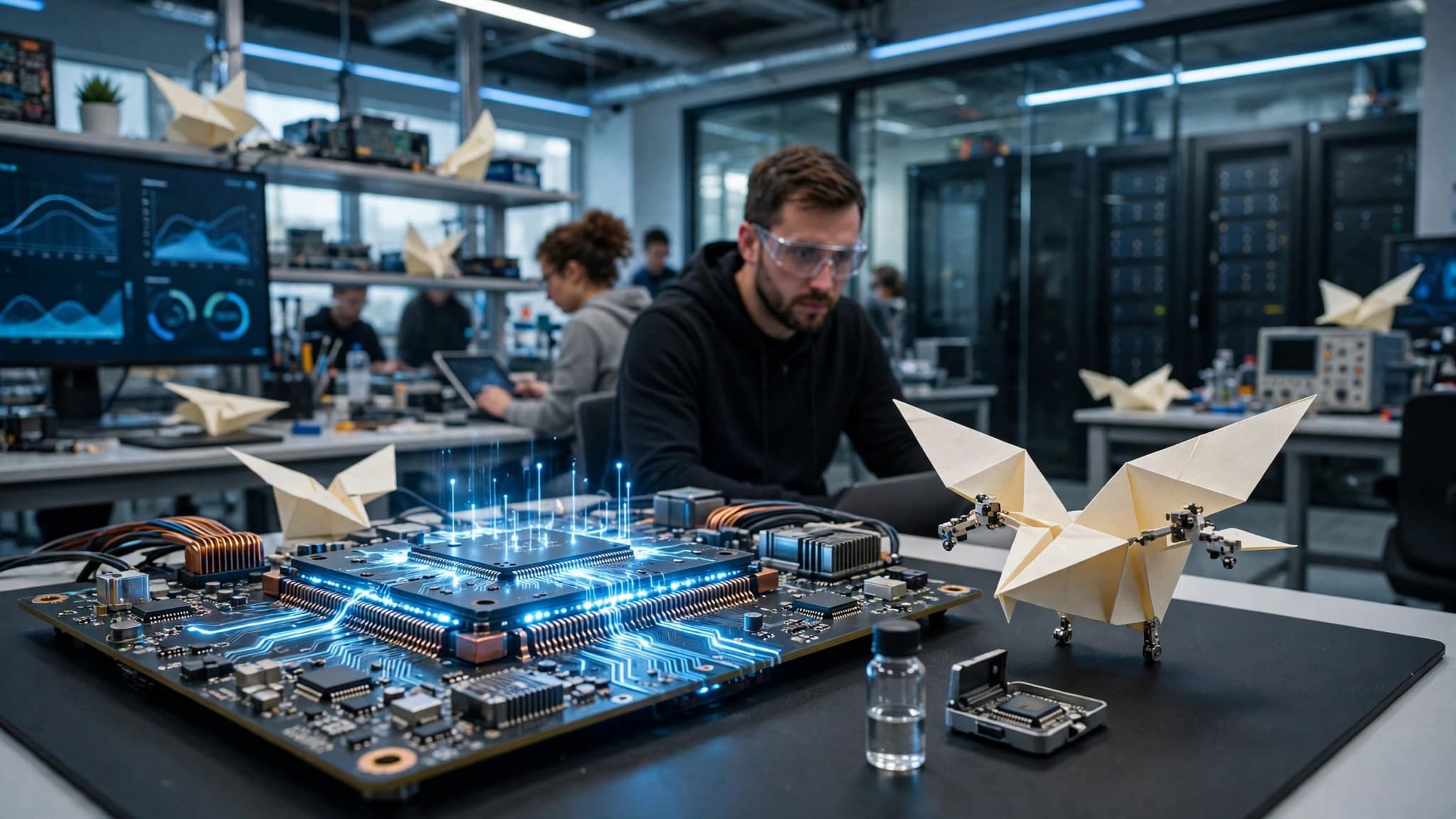
Here is the thesis. A training run today is thousands of small GPU programs — kernels — launched one after another, with idle gaps between each. A megakernel fuses them into one continuous program that runs the whole job.
Flapping Airplanes claims it has built "the world's most complete megakernel framework" — one program that can do an entire training run, serve inference, and even play a video game, all at the same time. The specific trick is overlap: run memory-bound inference (mostly waiting on data) alongside compute-bound training (mostly doing math), so the chip is rarely idle. The company's LinkedIn statement claims internal evidence "at trillion-parameter pretraining scale." Asher Spector's pitch line: "A model that's a million times more data efficient is probably a million times easier to put into the economy."
The pedigree is real, and this matters more than the pitch. The founders — Aidan Smith (Thiel fellow, ex-Neuralink), Asher Spector (Stanford statistics PhD), and Ben Spector (the CEO) — come with receipts: Ben was the 2024 lead author on ThunderKittens, an open-source toolkit for writing fast GPU kernels that working kernel engineers know and use. Sequoia's David Cahn called the founders' student accelerator Prod "one of the most powerful talent incubators in Silicon Valley." This is not three founders with a slide deck. It is three founders with a track record of doing the specific hard thing they claim they will do next.
Why the efficiency bet is suddenly worth $6 billion
For a decade, AI money flowed one way: bigger. More data, more chips, more data centers. That regime is now visibly straining. Goldman Sachs has hyperscalers spending roughly $800 billion in capex this year, rising to $1.2 trillion in 2027 and $1.4 trillion in 2028 — $7.6 trillion cumulative through 2031, needing about $300 billion a year in AI revenue just to break even. Earlier this month the Philadelphia Semiconductor Index lost more than $1.6 trillion in under two weeks as investors questioned the debt behind the data-center boom.
Meanwhile the canonical data-efficiency result keeps getting quoted for a reason. DeepMind's 2022 Chinchilla study found that GPT-3 was oversized and under-trained: a 70-billion-parameter model trained on far more data beat a 280-billion-parameter one at the same compute cost. The industry's instinct since has been "train bigger." The neolab investors are betting the next phase is "waste less." Index's post says it outright: the winners will be whoever gets the most out of every dollar, every megawatt, and every byte.
That is what $6 billion is buying: a hedge against the assumption that scale is free. If the efficiency gains are real, they compound across every data center on Earth — including the ones Nvidia sells chips into, which is presumably why Nvidia keeps showing up on these cap tables.
The skeptic's case is stronger than the press release
Now the part the announcement did not lead with. On Latent Space's AI News podcast in August, inference engineers laid out why megakernels keep failing in production: with tensor parallelism across GPUs, nonlinear steps like softmax force communication between chips no matter how fused your kernel is. Companies that tried megakernels, one engineer said, often revert to modular kernels "because you can optimize each individual component." And Nvidia's upcoming Rubin GPU design includes "dependency triggers" that, in one tech lead's public words, "kills mega kernels" — hardware evolving to remove the bottleneck fusion was solving.
Then there is the evidence gap. The $6 billion number is Bloomberg-reported, never company-confirmed. There are no published benchmarks, no papers, no speedups measured on chips anyone can buy. In February, Asher Spector could not give TechCrunch a commercialization timeline. Tech Funding News put it precisely: "The proof will be measured speed-ups on chips customers already own. Until the lab publishes them, the $6 billion rests on who is building it."
The honest counter-signal: megakernel work is not dead, just contested. Cursor open-sourced MoK, a training megakernel for NVL72 systems, claiming a 41% increase in tokens per second. The debate is whether the extreme version — one kernel for training plus inference plus a game, all at once — generalizes beyond demos, and whether production stacks keep it instead of modular kernels.
The neolab is the new biotech — without the milestones
Zoom out and the pattern is the story. Thinking Machines Lab raised $2 billion at $12 billion and already reports more than $200 million in annualized revenue. Nvidia has made 32 investments in startup model-makers, more than anyone else.
Dealroom's warning is worth reading twice: unlike biotech, neolabs "have no milestones and need to show results more often." Biotech has a ritual of proof — clinical trials. A neolab has the founders' word, the investors' conviction, and a clock that only ticks when someone publishes a benchmark.
What to actually watch
Ignore the valuation. Watch for one thing: the lab's first measured speedups on hardware customers already own. Tokens per second, memory saved, training runs shortened — against TensorRT-LLM and vLLM baselines. Until that exists, every number in this story is a bet, not a result.
To understand the technique rather than the money, start with ThunderKittens — Ben Spector's open-source kernel toolkit is the closest public window into how this team thinks. And if you are budgeting GPU capacity for next year: the smart money is betting efficiency, not more racks, is the binding constraint. Plan accordingly.
References
- TechCrunch — "Year-old AI lab Flapping Airplanes raises $1B at a $6B valuation"
- Dealroom — "Flapping Airplanes raises $1B at $6B with no product"
- Tech Funding News — "Flapping Airplanes raises $1B at $6B from Index and Lux"
- SiliconANGLE — "Year-old AI research lab Flapping Airplanes raises $1B at a reported $6B valuation"
- Index Ventures — "Toward more efficient AI: leading Flapping Airplanes' $1B Series A"
- Latent Space — "Megakernels are so dead and so back" (engineer skepticism)
- Dealroom — "AI neolabs are raising huge sums, most have little to show for it"
- KnowYourML — Chinchilla compute-optimal training summary
- Business Standard — "What are AI neolabs?"
Comments
More in Artificial Intelligence
What Is Rendezvous and Proximity Operations? (Cosmos 2612)
What is rendezvous and proximity operations? Cosmos 2612 flew one against a US satellite, closing to 500 meters — the closest unconsented rendezvous ever seen.
Read more