
What Does ASML Actually Do? The Machines Behind Every AI Chip

Mahmud Hasan
October 14, 2026
Today, a Dutch company most people have never heard of reported €11.7 billion in quarterly sales, a 57.5% gross margin, and customers asking to place orders for machines that will make chips in 2030. The company is ASML, and it makes one thing: the machines that print every leading-edge chip on Earth. Nobody else can make them. Not approximately — literally.
What ASML actually makes
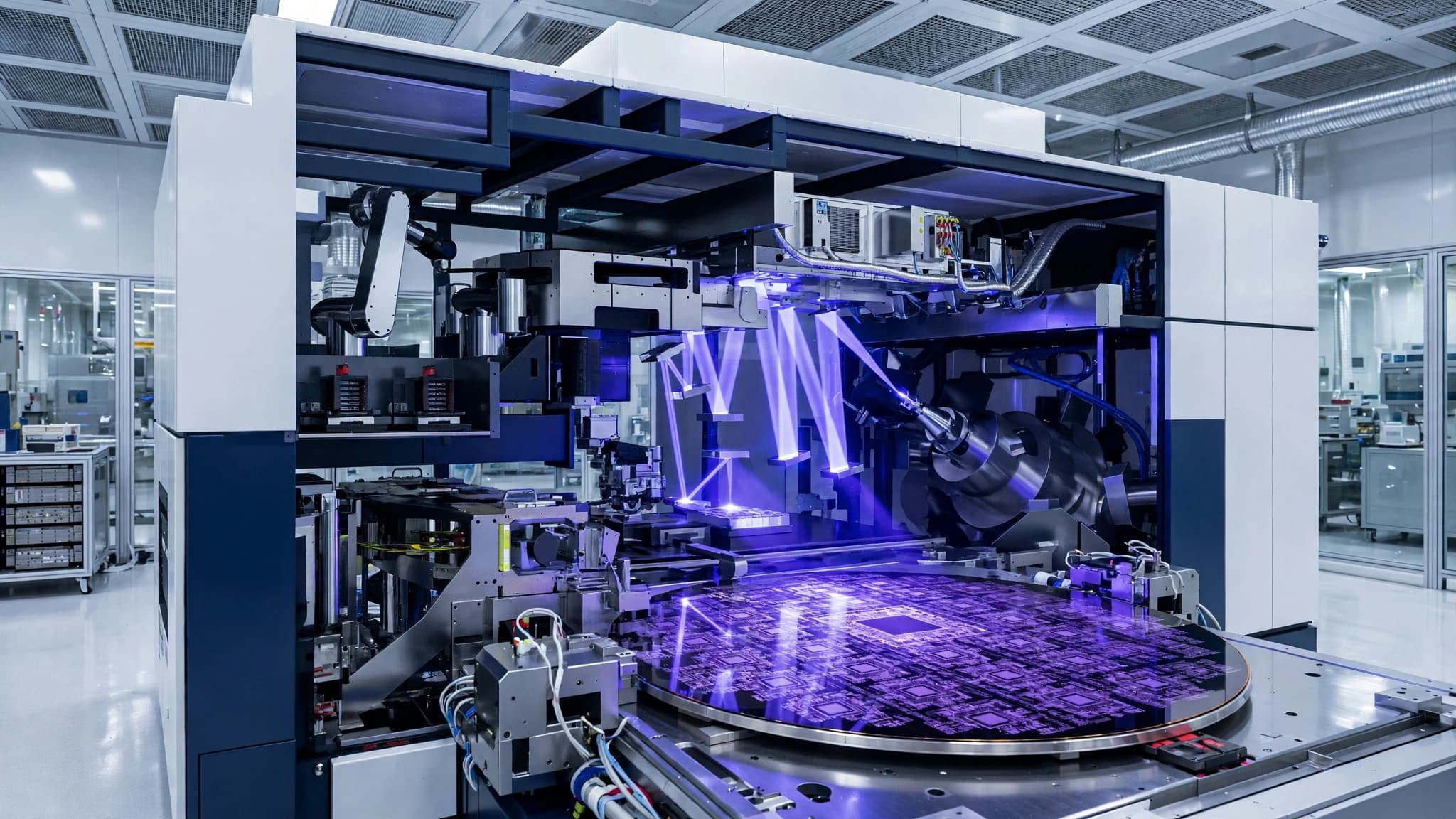
ASML builds lithography systems: machines that project circuit patterns onto silicon wafers. A beam of light shines through a stencil of the circuit design, shrinks it, and prints it onto the wafer — hundreds of times per wafer, hundreds of wafers per hour. Shorter wavelengths print smaller features: more transistors, faster chips, less power.
ASML's machines use extreme ultraviolet (EUV) light at a wavelength of 13.5 nanometers — roughly 14 times shorter than the 193nm deep-ultraviolet light of the previous generation, and nearly in the X-ray range. Here is the part that sounds made up: the light is generated by firing two pulses from a carbon-dioxide laser at microscopic droplets of molten tin, 50,000 times per second. Each tin droplet vaporizes into plasma hot enough to emit the EUV light.
And because EUV light is absorbed by nearly everything it touches — air included — the entire printing process happens inside a vacuum chamber, guided by mirrors instead of lenses. Those mirrors, made by Germany's Carl Zeiss, are polished to atomic-scale smoothness: if you scaled one up to the size of a country, its largest imperfection would be about a millimeter. Zeiss is the only supplier on the planet that can make them.
The finished machine has more than 100,000 parts, is roughly the size of a double-decker bus, ships in 40 separate containers, and is assembled on-site by ASML's own engineers. A standard EUV system sells for roughly €180 million. It is among the most complex machines ever built commercially, and there is exactly one company selling it.
Why the monopoly is real
ASML did not stumble into a monopoly; it outlasted one. Nikon and Canon walked away from EUV years ago and now compete only in the older DUV market. No competitor has shipped a single commercial EUV tool in the 20 years others have tried.
The moat is the supply chain, not just the blueprints. ASML spent roughly two decades and over $9 billion building the EUV stack with Zeiss and with Cymer, the laser maker it acquired in 2013. For EUV systems alone it relies on about 200 main suppliers and roughly 2,000 companies in the broader chain, and the two most critical pieces — Zeiss's mirrors and Trumpf's lasers — are German sole-source suppliers. Replicating it is estimated at over ten years and €20 billion; no one has come close.
That makes ASML the bottleneck of the entire semiconductor industry: TSMC, Samsung, and Intel all depend on its tools to print anything below about the 7nm node. It also makes ASML a geopolitical object. The company cannot sell EUV systems to China — Dutch export restrictions, in place since 2019 under US pressure, forbid it — and DUV restrictions followed. China fell from 36% of ASML's system sales in late 2025 to 19% in early 2026. ASML's own CEO has named Huawei as an important player in China's effort to build its own DUV equipment. On EUV, the Zeiss mirror monopoly blocks Chinese EUV entirely, and China's workaround — SMIC printing 7nm chips with older ASML DUV tools and repeated multi-patterning — costs more per good chip than a single EUV pass. Without state subsidies it doesn't pencil out.
Monopolies invite challengers, and export controls give China a very expensive reason to try. But the challengers have had two decades and billions to show for it, and the distance is widening, not shrinking.
The quarter that broke the pattern
Now the numbers, published this morning in Veldhoven. Third-quarter net sales of €11.7 billion — up from €9.3 billion in Q2 and €7.5 billion a year ago, a 56% year-over-year jump. Net income of €5.0 billion. Gross margin of 57.5%, at the high end of the company's own guidance. And €3.3 billion in installed-base revenue — the service, spare-parts, and upgrade contracts that turn a machine sale into a recurring annuity.
Then the guidance: €14.2 to €15.2 billion in sales for Q4, and €44–45 billion for full-year 2026. CEO Christophe Fouquet said customers are raising their short- and medium-term demand forecasts — and that some are expressing interest in placing orders stretching into 2029 and 2030. ASML's planned supply for 2027 and 2028 will already fall short of total customer demand, so the company is investigating expanding 2028 manufacturing capacity beyond the 30% increase it had already announced.
The company cannot make machines fast enough for demand that extends into the next decade. When TSMC, Intel, and Samsung all need your product and there is no alternative, your order book stops looking like a business metric and starts looking like a census of the industry's ambitions. ASML closed last year with €38.8 billion in backlog, €7.4 billion of it EUV — and the queue is still growing.
The €380 million bet on the next decade
The next act is already shipping. ASML's High-NA EUV systems — the Twinscan EXE:5200 — push the optics from a 0.33 to a 0.55 numerical aperture, printing features at roughly 8nm resolution: 1.7 times smaller than before, good for nearly 3 times the transistor density, at over 200 wafers per hour. Each one costs more than $380 million.
Intel took the world's first commercial EXE:5200 in late 2025 and completed acceptance testing this year, aiming it at its 1.4nm-class process. TSMC — which initially balked at the $400 million price tag — had come around by early this year: for 1.6nm and 1.4nm designs, High-NA is no longer optional. This is how the monopoly compounds. The customers argue about timing, not about whether they buy from ASML.
ASML guides to €44–60 billion in annual revenue by 2030 on the High-NA ramp. AI is the demand behind the demand, but Fouquet himself has cautioned that AI's effect on chipmaking will unfold over ten to fifteen years, not overnight. The machines being ordered today for 2030 delivery are that timeline, in hardware form.
What it means for everyone else
For investors, ASML is the purest picks-and-shovels play in semiconductors: whether Nvidia or AMD wins the next AI cycle, the wafers run through ASML tools, and the service contracts keep paying after the sale. The AI boom is usually described as a fight between model labs and chip designers. The quiet truth is that both of them stand on a Dutch machine shop with one supplier of mirrors, one supplier of lasers, and a two-decade head start.
What to watch next: the High-NA ramp through 2027–2030, TSMC's move to its 1.4nm-class node, and the order book — if customers keep pushing commitments into 2030, the shortage story, not the cycle story, is the one that matters. The most important company in the AI supply chain doesn't make chips or train models. It makes the only machines that make the machines that do. Today's quarter is what that looks like when it's working.
References
- ASML Q3 2026 results (official press release, October 14, 2026) — globenewswire.com
- ASML Q3 sales breakdown and Fouquet's 2029–2030 order comments — misryoum.com
- "ASML says AI's effect on chipmaking will unfold over the next 10 to 15 years, not overnight" — techspot.com
- ASML investment case: EUV monopoly pricing and 2030 guidance — heygotrade.com
- Intel's $380M High-NA EUV bet and EXE:5200 specifications — financialcontent.com
- China lithography progress and export-control facts — github.com/tobias-weiss-ai-xr/lithography-research
Comments
More in Hardware & Gadgets

Workday Bought C1.ai to Give AI Agents a Login. Here's What Agentic Identity Management Actually Is
Workday just agreed to buy C1.ai, an identity platform for AI agents. Here is what agentic identity management actually does — and why your agents logging in as you is the part that should worry you.
Read more