
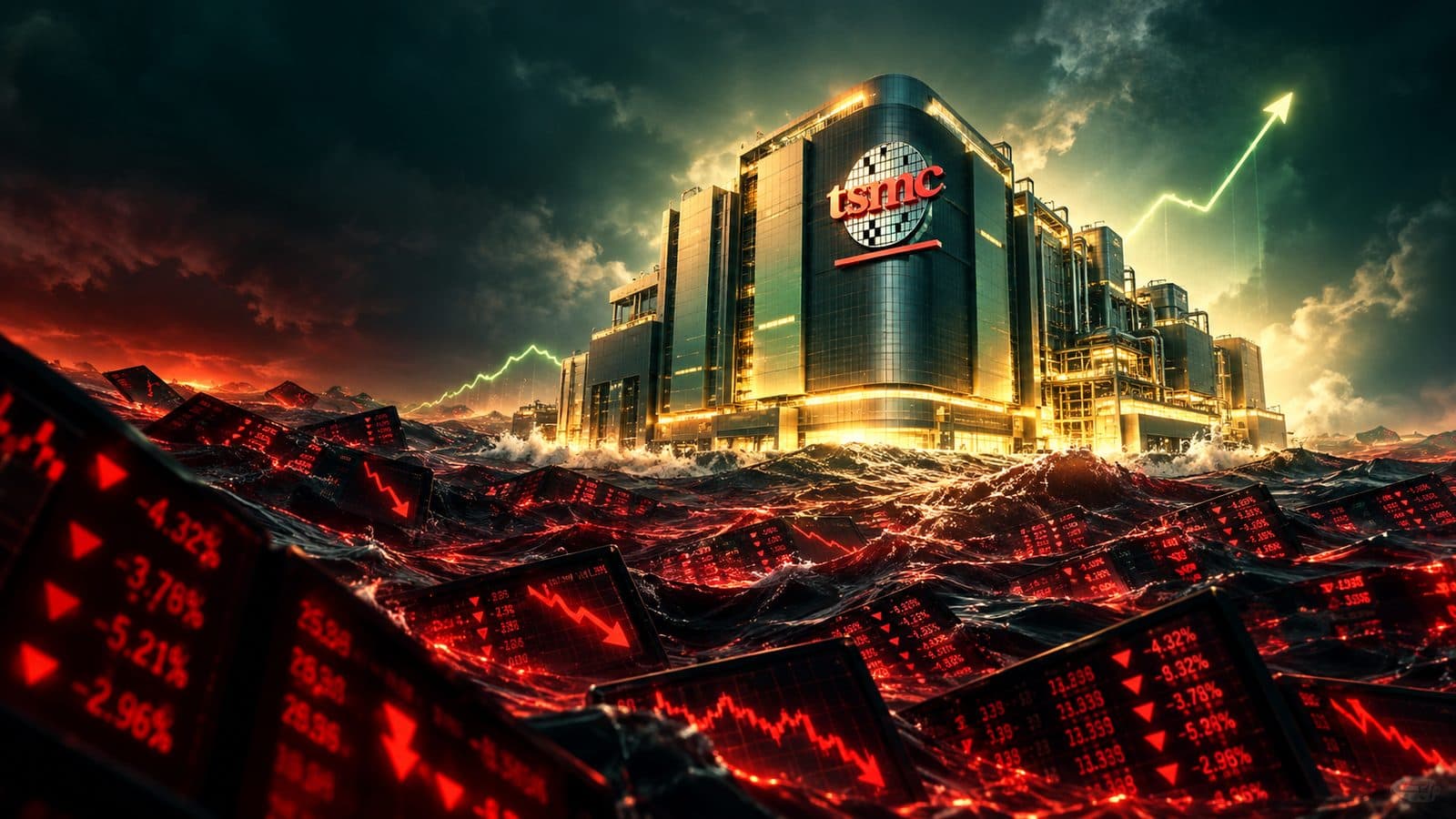
TSMC Just Hit $2.5 Trillion. Four of Every Five Stocks Didn't.

Mahmud Hasan
October 6, 2026
The $2.5 trillion milestone nobody should misunderstand
On Monday, Taiwan Semiconductor Manufacturing crossed a line only a handful of companies have ever touched. Its American depositary shares closed at $485.80, up 2.75% on the day, after touching an intraday record of $487.47 — pushing its market value to roughly $2.5 trillion. Back in Taipei, the stock closed at NT$2,575, an all-time high that valued the company at about NT$66.9 trillion and dragged the TAIEX index to its own record close of 49,712.04.
The Nasdaq hit a record the same day. The S&P 500 hit a record too. And yet something was off: while the indexes printed new highs, Monday marked the 15th consecutive trading day on which the number of stocks hitting new lows exceeded those hitting new highs. Four out of five Russell 3000 stocks now trade below their 50-day moving average, and the share above the 200-day average has fallen to just over 40% — the lowest reading this year.
So the headline reads "record highs" and the market's internals read "distress." Both are true. TSMC's $2.5 trillion is the clearest illustration of the contradiction: this is the narrowest rally in a generation, and one company is doing most of the carrying.
The numbers doing the heavy lifting
Let's start with what's earned, because TSMC's valuation isn't pure vibes. The stock is up roughly 82% from its 52-week low of $266.82, and 55–60% year to date. August revenue jumped 53% year over year, and full-year 2026 revenue growth is projected at slightly above 40% in US dollar terms. The company is spending $60–64 billion in capital expenditure this year just to keep pace with demand.
The next checkpoint is nine days away: third-quarter results land on October 15. Analysts expect adjusted earnings of $4.40 a share — up 54% from $2.84 a year earlier — on about $45.3 billion of revenue. Consensus is a buy across 17 analysts, with an average price target of $523.22, roughly 8% above Monday's close.
The moat behind the multiple is physical, not narrative. TSMC accounts for an estimated 72.5% of global foundry revenue, and it is effectively the only company that can manufacture the most advanced chips at scale. Nvidia's $5.76 trillion market cap — it closed at a record too — exists because TSMC can build its processors fast enough. Micron signed TSMC to produce the base dies and advanced packaging (CoWoS) for its next-generation HBM memory. Without TSMC, the AI buildout has a blueprint and no factory.
The near-term catalyst, per Monday's tape, was chatter: early talks with Elon Musk's Terafab about a chip manufacturing facility in Texas. Those are discussions, not a signed deal. When markets trade on rumors this size, watch them carefully.
The rally that isn't one
Now the other half. The Philadelphia Semiconductor Index — the benchmark for the very sector TSMC leads — rose just 0.28% on Monday's record day. Intel fell more than 2%. So did Qualcomm. ARM, ASML, and AMD all closed lower. UMC's ADR plunged 8.95%. Among memory names, Western Digital surged 6% while Micron, SanDisk, and SK Hynix declined — with SK Hynix stuck below its 20-day moving average.
That's not a semiconductor rally. That's one company, plus Nvidia and Broadcom, carrying an index while their peers sink. Fundstrat's breadth data makes the divergence explicit: only about 20% of Russell 3000 constituents sit above their 50-day moving averages. Goldman Sachs notes that fundamental long-short funds have cut net exposure to roughly the 2nd percentile of the last five years. The professionals are positioned for trouble; the indexes are priced for euphoria.
There's a name for this structure: concentration. The AI trade has become a bet on a shrinking list of companies — the chipmakers, the model builders, the hyperscalers buying capacity. Everything else is treading water or sinking, and the index masks the split.
The bond market's completely different story
While stocks celebrated on Monday, the bond market priced in something close to fear. The 10-year Treasury yield hit 5.34% and the 30-year reached 5.70% — both their highest since 2002. The September ISM Services PMI slipped to 54.9, but the services price index climbed from 72.6 to 74.0, its highest level in four years. That's the classic stagflation cocktail: growth cooling, prices accelerating, borrowing costs at quarter-century highs.
This is the contradiction in one frame. Equity markets are discounting an AI productivity boom led by TSMC and Nvidia. Bond markets are discounting persistent inflation and expensive capital for everyone else. The uncomfortable truth is that both can be right at once: AI capital expenditure can concentrate into a few trillion-dollar winners while higher rates quietly strangle the other 80% of the market.
The capex numbers show why the winners keep winning. Nvidia expects the five biggest AI hyperscalers to spend nearly $800 billion on data center capital expenditure this year, rising to $1.3 trillion next year and $3–4 trillion annually by 2030. As long as that spending holds, TSMC's order book is a mathematical certainty — which is exactly what makes it a concentration risk rather than a broad-market bet.
So is it a bubble?
The honest answer: the people calling it a bubble and the people dismissing it are looking at different data. DBS Group argued recently that Nvidia's price-to-earnings ratio, against projected 70% earnings growth next year, puts AI leaders "far from bubble territory." TSMC's 34.65 trailing P/E against 40%+ revenue growth isn't the 1999 script.
But 1999's excess was also concentrated — it was just concentrated in different tickers. The red flags here aren't valuation multiples; they're the breadth collapse, the 15 straight days of new lows outnumbering new highs, the professional funds derisking to historic lows, and the bond market's 24-year-high yields. A rally can be fundamentally justified and structurally fragile at the same time.
TrendForce flagged one more test to watch inside TSMC itself: rising depreciation and startup costs from the 2-nanometer ramp and overseas fabs could pressure gross margins, even as third-quarter guidance holds at 65–67%. A company can be indispensable and still miss its own margins.
What this means for the rest of us
For working engineers and builders, the signal is practical, not prophetic. First: the AI capex supercycle is real and it is physical — it runs through fabs, packaging plants, and base dies, which means infrastructure and hardware-adjacent skills stay in demand as long as the $800-billion-to-$3-trillion spending curve holds. Second: don't confuse index highs with broad health. If your employer, your client, or your portfolio isn't in the AI supply chain, their environment looks more like the bond market than the Nasdaq. Third: October 15 is the next real checkpoint — TSMC's earnings call will either confirm the 54% EPS growth the stock is priced for or expose how much of this rally is concentrated hope.
The $2.5 trillion milestone is deserved. Just don't mistake it for a market that works.
References
- AI Rally Continues as Nasdaq Hits Record High; Nvidia Market Cap Nears $5.8 Trillion — BigGo Finance
- TSMC stock hits record high as AI chip demand lifts Taiwan market — Crypto Briefing
- Tech Stocks Propel Nasdaq to New Highs, 10-Year U.S. Treasury Yield Hits Highest Since 2002 — CoinTime
- Asia Chip & AI Stocks Swing — Gotrade News
- TSMC stock gains ahead of earnings — ad-hoc-news
- Nvidia and Micron Can't Make AI Chips Without This Growth Stock — Motley Fool
Comments
More in Technology

Google Paused Its Open-Source Bug Bounty. AI Report Spam Is Why.
On October 1, Google stopped accepting vulnerability reports to its open-source bug bounty — because AI made filing reports nearly free while verifying them still takes a human. Intel, curl, and the Linux kernel are drowning in the same flood.
Read more
A 9.9 in GitLab's AI Gateway — and Upgrading GitLab Won't Fix It
GitLab's self-hosted AI Gateway has a 9.9 sandbox-escape flaw — and patching GitLab itself won't fix it. Here's what's broken, who needs to act, and the pattern nobody's talking about.
Read more
Node.js Is Slowing Down on Purpose. The Reason Is a Maintainer Crisis.
One release a year, every release LTS — it sounds like a gift to developers. The numbers behind Node.js's schedule change tell a different story.
Read more